
Description
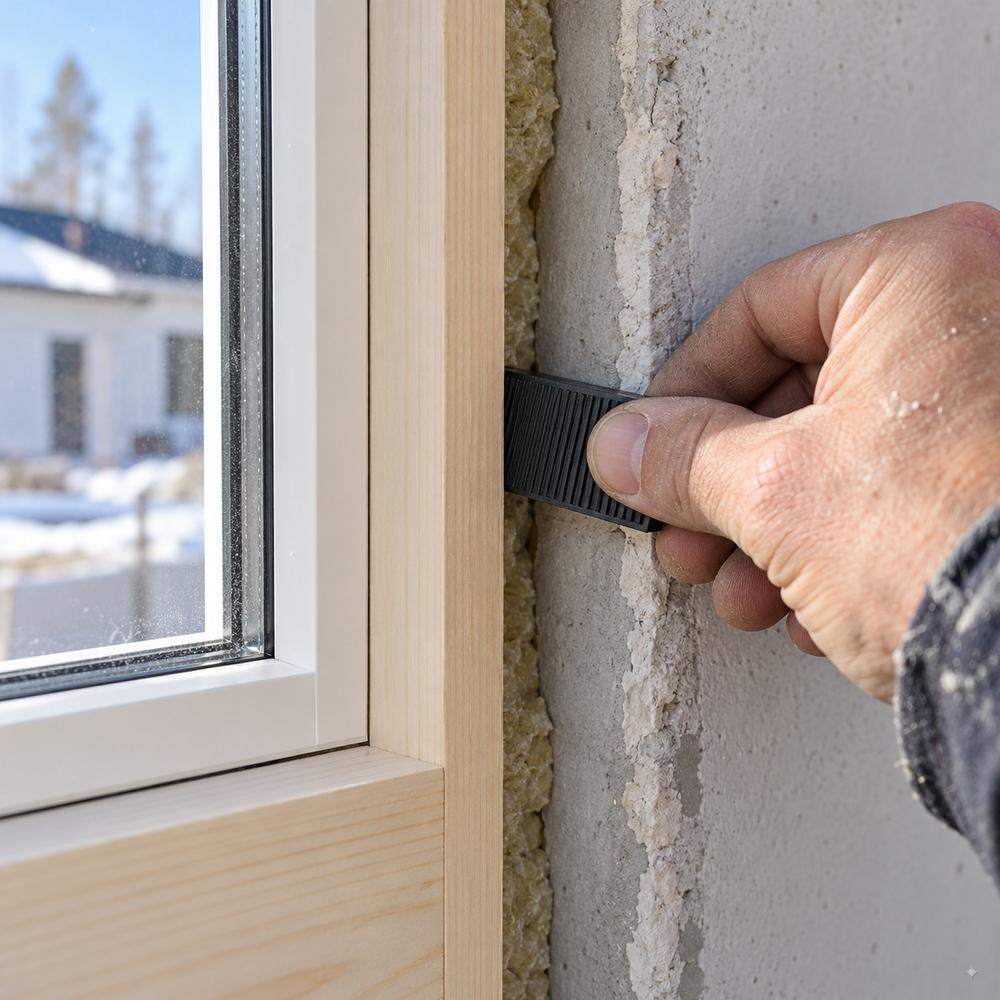
The Procat plastic installation wedge is a toothed plastic wedge for making expansion gaps and supporting workpieces. The pack contains 50 wedges. The wedges are black plastic, and their surface has transverse teeth.
The teeth are the same on both sides, so two wedges lock together, when placed face to face on top of each other. This turns a pair of wedges into a spacer of even thickness, whose thickness is adjusted by sliding the wedges against each other. The teeth stop the wedges slipping out of place under load.
The wedges can be used singly, in pairs, or with several stacked on top of each other when a larger gap is needed. A single wedge gives tapering support, a pair of wedges straight, even support.
The thick end of the wedge has through holes. Through these holes the wedge can be pulled out with a screwdriver or pliers even when it is pressed tight between the parts being installed. The plastic does not absorb moisture or swell, so the wedge also comes out in wet conditions.
Intended use and suitability:
The wedges hold a component at the right distance from another structure during installation or support a workpiece in place while it is fixed.
- Floor expansion gaps: when laying laminate, parquet and vinyl planks, the wedges keep the expansion gap between the flooring and the wall constant throughout the installation.
- Door and window frames: supporting the frame and adjusting it straight before fixing and tightening the frame screws.
- Board installation: lifting boards off the floor and keeping the joint gap in plasterboard and chipboard work.
- Levelling furniture: fine-adjusting the height of a cabinet or worktop on an uneven base.
- Temporary support: holding a workpiece in place while glue dries or during fixing.
Package contents:
- 50 pcs toothed plastic wedges
Features:
- Toothed surface: two wedges lock together and do not slip under load.
- Adjustable thickness: sliding a pair of wedges gives a spacer of even thickness at the required height.
- Stackable: several pairs of wedges on top of each other cover larger gaps.
- Through holes: the wedge can be removed with a screwdriver or pliers even when pressed in tight.
- Plastic construction: does not absorb moisture, swell or split like a wooden wedge.
- 50 pcs pack: enough to wedge the flooring installation of one room at a time.
- Reusable: the wedges are removed after installation and used again.
Technical specifications:
- Material: plastic.
- Shape: wedge with transverse teeth on the surface on both sides.
- Removal: two through holes at the thick end of the wedge.
- Colour: black.
- Wedges per pack: 50 pcs.
- Method of use: singly, as a pair or stacked.
Procat plastic installation wedge instructions for use:
Floor expansion gap: Place the wedges between the flooring and the wall about every 40-50 cm and at each corner. Use a pair of wedges when the gap is larger than the tip of a single wedge: place the wedges with the teeth facing each other and slide them in opposite directions until the gap is filled. Check the width of the gap with a measure before laying the next row.
Supporting a frame: Push a pair of wedges between the frame and the wall at the hinge, the lock and the middle of the frame. Adjust the frame straight with a spirit level by sliding the pair of wedges, and only tighten the frame screws once the frame is straight.
Large gap: Stack two or more pairs of wedges on top of each other. Place the wedges so that the teeth lock together at every layer.
Removal: Push the tip of a screwdriver or the nose of pliers into the hole in the wedge and pull the wedge out. Only remove the wedges once the fixing is done and the structure stays in place on its own.
Maintenance: Wipe glue and filler residue off the wedges before storing; hardened residue fills the teeth and stops them locking.
Warnings:
- The wedges are not a structural support: do not use them to support a load-bearing structure, a wall element or a heavy load.
- Do not drive a wedge in place with a hammer at full force; the plastic can break and fragments can fly off.
- An overloaded wedge can slip out of the gap suddenly and drop the supported workpiece.
- Remove the wedges from the floor expansion gap after installation; a wedge left in place prevents the floor from moving and causes the floor to buckle.
- Plastic dissolves and softens in solvents; do not use the wedges with solvent-based substances for long periods.
- Keep out of reach of children: a small hard object is a choking hazard.
Frequently asked questions (FAQ):
How does the Procat plastic installation wedge differ from an ordinary wedge? The surface of the wedge is toothed, so two wedges lock together and form a spacer of even thickness that does not slip.
How wide an expansion gap can the wedges give? The width of the gap is adjusted by sliding a pair of wedges; with a single wedge the gap tapers with the shape of the wedge, and stacking pairs of wedges covers larger gaps.
How do I get a wedge out if it is pressed in tight? The thick end of the wedge has through holes into which you push the tip of a screwdriver or the nose of pliers.
Can the wedges be reused? Yes. Plastic wedges do not swell or split, so they are removed after installation and used again.
Why a plastic wedge rather than a wooden one? Plastic does not absorb moisture, so the wedge does not swell tight in the gap or split under load like a wooden wedge.
How many wedges are needed for a floor installation? The wedges are placed about every 40-50 cm along the wall and in the corners; a pack of 50 wedges is enough to wedge an ordinary room.
Recycling instructions:
Sort wedges that are no longer used into plastic collection or the energy fraction according to local instructions. Remove glue, filler and paint residue from the wedges before sorting; heavily soiled wedges go in mixed waste. Sort the clear plastic shell of the packaging into plastic collection and the cardboard part into carton collection.