
Description
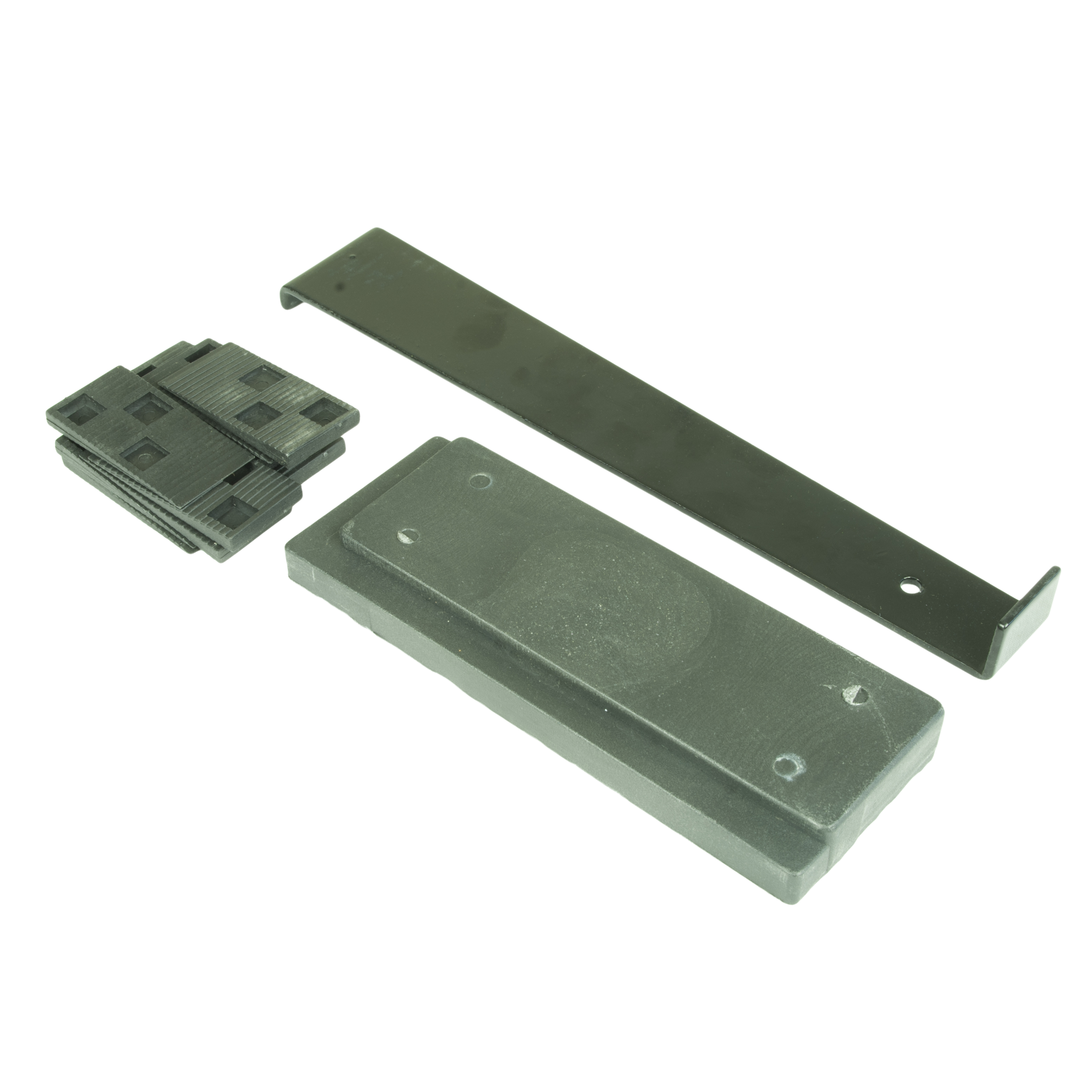
The Procat laminate installation set is a three-part tool set for installing floating floors. The set includes 30 installation wedges, a tapping bar and a tapping block, the three tools needed to assemble the click joints of laminate, vinyl and parquet planks. The set weighs 630 g.
The triangular wedges are placed between the flooring and the wall to keep the expansion gap constant throughout the installation. The tapering shape of the wedge gives stepless adjustment, and two wedges placed face to face form a spacer of even thickness, whose size is changed by sliding the wedges against each other. Stacking several wedges increases the gap when a wider gap is needed next to the wall.
The tapping block is used on the long side and the end of the board: the block is placed against the edge of the board and struck with a hammer, so that the blow is spread over a wide area of the board edge and no point load is applied to the tongue. Striking the board directly breaks the thin lip of the click profile, after which the joint no longer locks tightly.
The tapping bar (or pull bar) is needed to install the last board and the boards along the walls, when there is no longer room for the block at the end of the board. One hook of the bar is placed over the end of the board and the other end is struck with a hammer, so that the pull is applied to the end of the board and the joint closes. Tools available separately for the same job are Procat installation wedge, plastic, 50 pcs and the heavier Edma parquet tapping bar PRO.
Intended use and suitability:
The set is intended for installing flooring with click and tongue-and-groove joints, where the floor is laid floating without fixing it to the subfloor and an expansion gap is left next to the walls.
- Laminate flooring: the wedges keep the expansion gap constant, the block closes the long-side joint and the bar pulls the last row into place next to the wall.
- Vinyl and composite planks: closing the click joint with the block without denting the edge of the plank.
- Floating parquet: tightening the tongue-and-groove joint and adjusting the straightness of the rows during installation.
- Sizing the expansion gap: stacking wedges sets the gap between the floor and the wall to the size required by the flooring material before the skirting boards are fitted.
- Next to frames and pipes: the tapping bar reaches places the hammer and block cannot get to.
Package contents:
- 30 pcs triangular installation wedges
- 1 pcs tapping bar (pull bar)
- 1 pcs tapping block
Features:
- Three tools in the same pack: the wedges, block and bar cover the work stages of installing a floating floor from the start to the last row.
- Stackable wedges: the triangular shape gives a stepless joint gap, and two wedges face to face form a spacer of even thickness.
- Load-spreading tapping block: the blow is transferred to the edge of the board over a wide area, so the lip of the click profile does not break.
- Hook-ended tapping bar: reaches between the wall and the board in tight spots where the block does not fit.
- Set weight 630 g: light to carry from site to site.
Technical specifications:
- Parts: 3 types (wedges, tapping bar, tapping block).
- Number of wedges: 30 pcs.
- Wedge shape: triangular, stackable.
- Tapping bar: hook-ended pull bar for installing the last row.
- Tapping block: a striking block that spreads the blow against the edge of the board.
Procat laminate installation set instructions for use:
1. Setting the expansion gap: Lay the first row next to the wall and push the wedges between the flooring and the wall about every 40–60 cm. Adjust the gap by pushing the wedge in further or by placing two wedges face to face. Check that the gap is the same along the whole wall.
2. Assembling the rows: Click the board into the previous row and close the joint by placing the tapping block against the free edge of the board. Strike the block with a hammer using short blows and move the block along the edge until the joint is closed along its whole length. Do not strike the board directly with the hammer.
3. Last row and ends: Place the hook of the tapping bar over the end of the board and the other end towards the wall. Strike the striking end of the bar with a hammer until the end joint closes. Work with short blows and check the joint after each blow.
4. Finishing: Only remove the wedges once the whole floor is installed and the glue or locking has settled. Cover the expansion gap with a skirting board or cover strip so that the strip is fixed to the wall, not to the floor.
Maintenance: Wipe glue and dust off the bar and block after use. Keep the wedges together in one bag so that they do not get lost.
Warnings:
- Wear safety glasses: a hammer blow can throw splinters from the edge of the board or from the block.
- Only strike the striking surface of the block or tapping bar with the hammer, not the edge of the board or the hook of the bar.
- Keep your other hand away from the striking area; the tapping bar can slip off the end of the board during a blow.
- Check the condition of the block and bar before use. A cracked block or a bent bar directs the blow incorrectly.
- Do not use the tapping bar as a lever or crowbar.
- Keep out of reach of children. The wedges are small parts.
Frequently asked questions (FAQ):
What does the Procat laminate installation set include? The set has 30 triangular installation wedges, a tapping bar and a tapping block.
Why is a gap left between the laminate and the wall? Wood-based flooring moves with humidity and temperature. The expansion gap lets the floor expand and contract without buckling against the wall. With the wedges, the gap stays the same throughout the installation.
How is the width of the expansion gap adjusted with the wedges? A single wedge gives tapering support, whose size is changed by pushing the wedge in further. Two wedges face to face form a spacer of even thickness, and stacking wedges gives a wider gap.
Can I strike a floorboard with a hammer without a tapping block? No. A direct hammer blow breaks the thin lip of the click profile, so the joint no longer locks. The block spreads the blow over a wide area of the board edge.
When is a tapping bar needed? In the last row and at end joints, where there is no longer room for the block between the board and the wall. The bar is hooked over the end of the board and struck from the wall side.
Is the set suitable for vinyl planks? Yes. The wedges, block and bar are used in the same way with all floating click-joint flooring materials.
Recycling instructions:
Take apart a Procat laminate installation set that is no longer used and sort it by material: metal parts to metal collection, plastic parts to plastic collection and wooden parts to wood waste or the energy fraction. Cardboard packaging to carton collection. It is worth keeping intact parts for the next installation.