


Description
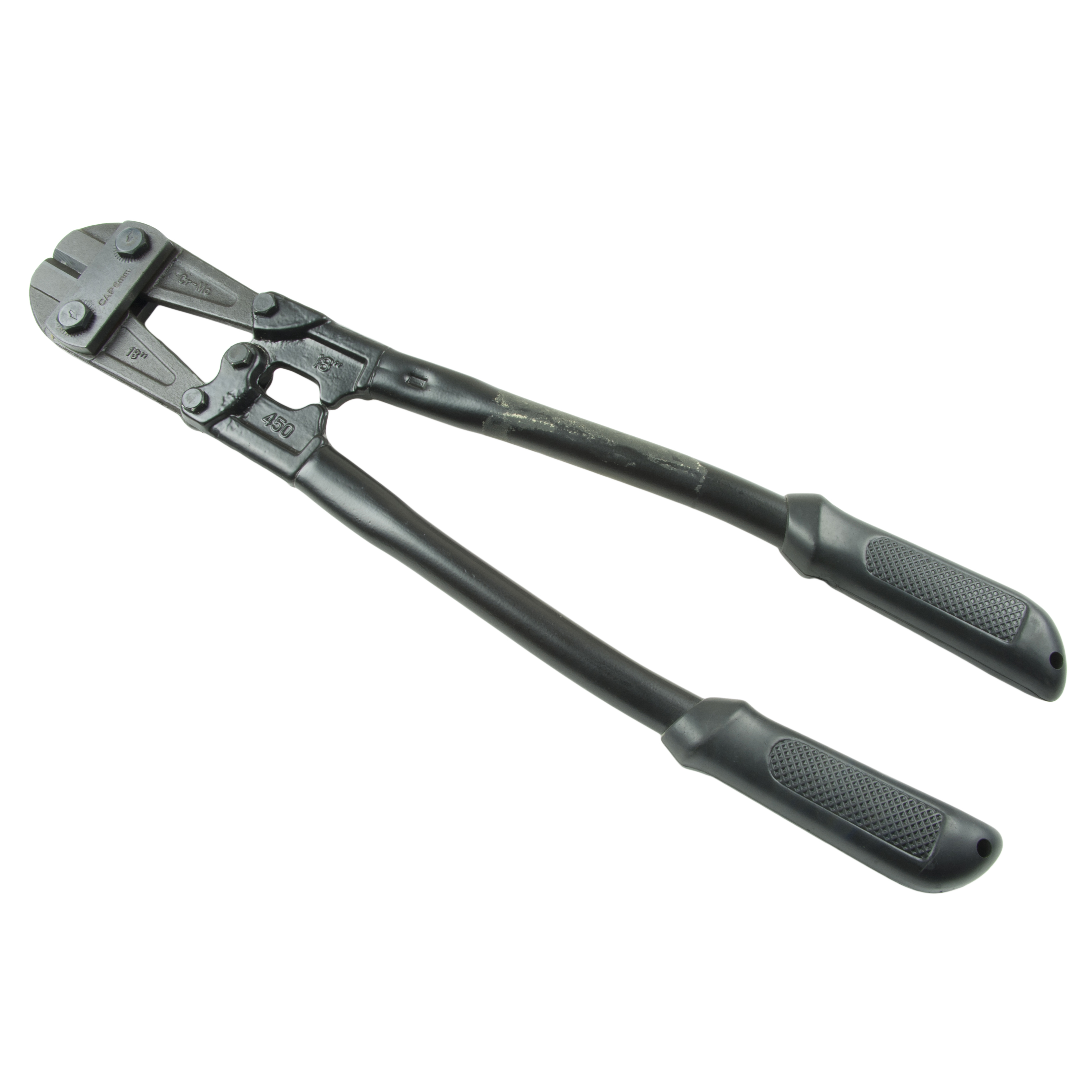
Procat bolt cutters cut bolts, chains, reinforcing bars and wire rope by hand. The jaws are hardened Cr-Mo steel (chrome molybdenum steel) and they are bolted to the jaw housing, so a worn pair of cutting jaws can be removed and replaced instead of the whole tool. The range covers five lengths: 200, 450, 600, 750 and 900 mm.
The power of the tool comes from a two-stage joint mechanism: the movement of the handles is transferred through the joint to the jaws as a multiplied squeezing force. The longer the handles, the greater the leverage and the thicker the material the cutters can cut. The short 200 mm model fits tight spots and a one-handed grip, while the 750 and 900 mm models are intended for thick bars and chains.
The handles are tubular steel and have ribbed plastic grips at the ends, which keep your grip in place even with gloves. The body and handles are painted black, and the tool size is marked on the jaw housing. The adjusting bolts of the joints let you adjust the jaw clearance as the joints wear in use.
For cutting thin sheet metal and plates, use Procat tin snips and for handling live conductors Procat VDE pliers. The bolt cutters are not insulated, so they are not suitable for live work.
Intended use and suitability:
Bolt cutters cut round, soft steel pieces by squeezing. The size is chosen according to the thickness of the piece to be cut and the working space.
- Construction sites: reinforcing bars and mesh, threaded rods and tie wire; the 600–900 mm models for thick bars.
- Maintenance and repair work: rusty bolts, fixing chains and padlock shackles; the 450 mm model for general use.
- Warehousing and logistics: metal seals, straps and chains when unpacking shipments.
- Tight spots: the 200 mm model inside enclosures and cabinets where long handles have no room to move.
Package contents:
- 1 pcs bolt cutters in the selected size (200, 450, 600, 750 or 900 mm)
Features:
- Hardened Cr-Mo steel jaws: chrome molybdenum steel keeps its cutting edge in repeated use.
- Replaceable jaws: the pair of cutting jaws is bolted on, so a worn jaw can be removed.
- Adjustable joint: adjusting bolts restore the jaw clearance as the joints wear.
- Two-stage joint mechanism: multiplies the hand force applied to the handles.
- Ribbed plastic grips: a secure grip even with work gloves.
- Five sizes: 200–900 mm, from tight spots to thick bars.
Technical specifications:
- Lengths: 200, 450, 600, 750 and 900 mm.
- Jaw material: hardened Cr-Mo steel (chrome molybdenum).
- Jaw construction: bolted, removable pair of cutting jaws.
- Joint: two-stage, with adjusting bolts.
- Handles: tubular steel, ribbed plastic grips.
- Surface finish: painted.
- Materials cut: soft and medium-hard steel: bolts, chains, reinforcing bars, wire rope.
Procat bolt cutters instructions for use:
Choosing the size: Choose the length according to the thickness of the piece to be cut. If the jaws do not bite, the tool is too small, so do not carry on by force.
Positioning: Place the piece as deep between the jaws as possible, close to the joint where the squeezing force is greatest. Keep the cutters at right angles to the piece.
Cutting: Squeeze the handles evenly with both hands. Do not jerk or twist the cutters sideways while cutting.
Adjustment: If the jaws do not meet, adjust the adjusting bolts of the joint in small steps until the jaws close evenly along the whole cutting length.
Maintenance: Clean the jaws after use, oil the joints lightly and store in a dry place.
Warnings:
- Do not cut live wires or cables, as the handles are not insulated.
- Wear safety glasses and protective gloves: the cut-off end can fly off with force.
- Do not exceed the cutting capacity of the cutters and do not extend the handles with a pipe, as the jaws will chip and the joint will bend.
- Do not cut hardened steel, spring steel or a lock shackle marked as cut-resistant.
- Support the piece being cut so that it does not fall or spring away after cutting.
- Keep out of the reach of children.
Frequently asked questions (FAQ):
Which size of Procat bolt cutters is suitable for cutting a lock? For the most common padlock shackles, 450 or 600 mm is enough; thicker shackles need the leverage of 750 or 900 mm.
Can bolt cutters cut wire rope? Yes, as long as the thickness of the rope stays within the cutting capacity of the cutters. It is worth taping braided wire rope before cutting so the strands do not unravel.
Why do the jaws not cut the bar all the way through? Usually the joint clearance has increased. Adjust the adjusting bolts until the jaws close evenly.
Can the jaws be replaced? The pair of cutting jaws is bolted on and removable, so a worn jaw can be replaced with an equivalent one.
How are the jaws maintained? Clean them after use, oil the joints lightly and avoid knocks; storing them dry prevents rust.
Recycling instructions:
Sort discarded bolt cutters into metal collection. The plastic grips can be removed and sorted into plastic waste if they come off intact; otherwise, take the whole tool to metal collection.