

Description
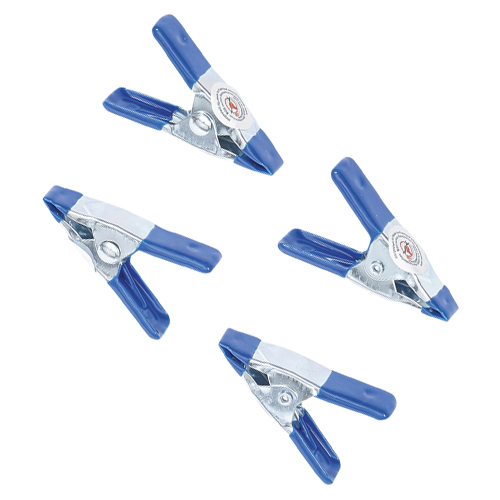
The BGS mini clamp set 50 mm contains four metal-bodied spring clamps with a jaw opening of 50 mm. The clamps are intended for holding small workpieces during gluing, fitting and assembly.
The clamping force comes from a spring. Squeezing the handles opens the jaws, and when the handles are released, the spring closes the jaws around the workpiece. Clamping and releasing can be done with one hand, and the clamp does not need to be adjusted to the thickness of the workpiece.
The handles and jaws are rubber dip-coated. The rubber coating on the jaws spreads the clamping force over a wider area and prevents dents in soft materials such as wood, foam and painted surfaces. The coating on the handles improves grip when opening the clamp.
Four clamps are enough to clamp a workpiece at several points, for example at both ends of a glue joint at the same time.
Uses and suitability:
A mini clamp is used where little clamping force is needed but the workpiece must be held still for the whole curing or working time.
- Gluing: glue joints in small wood, plastic and cardboard parts where the glue needs pressure while it cures.
- Scale models and hobby work: holding parts in place while fitting and drying without marking the workpiece.
- Vehicle work: temporarily holding upholstery, trim strips and light parts in place during installation.
- Workshop and garden: clamping a guide, stop or tape measure to the worktop and holding light supports in place.
- Desk: clamping a stack of paper, a film or a drawing to the edge of the table.
Package contents:
- 4 spring clamps, jaw opening 50 mm
Features:
- Spring mechanism: the clamp closes by itself and stays closed without hand force.
- One-handed use: clamping and releasing work while your other hand is free to hold the workpiece.
- Opening 50 mm: covers thin boards, strips and scale model parts.
- Metal body: withstands repeated use and keeps the jaws aligned.
- Rubber-coated jaws: spread the clamping force and prevent dents in soft and painted surfaces.
- Rubber-coated handles: improve grip when used by hand.
- Four clamps: the workpiece can be clamped at several points at the same time.
Technical specifications:
- Clamps: 4 pcs.
- Jaw opening: 50 mm.
- Body material: metal.
- Jaw coating: rubber, dip-coated.
- Handle coating: rubber, dip-coated.
- Mechanism: spring clamp, hand-operated.
BGS mini clamp set 50 mm instructions for use:
1. Preparation: Check that the rubber coating on the jaws is intact; a bare metal jaw leaves a mark on a soft surface. Also check that the spring moves freely and the jaws close in line.
2. Opening: Squeeze the handles together to open the jaws. Open the jaws wider than the thickness of the workpiece.
3. Positioning: Place the jaws around the workpiece so that their whole surface makes contact and the clamp is at right angles to the joint. Release the handles slowly so that the spring closes the jaws. A clamp placed at an angle pushes the parts sideways.
4. Using several clamps: Space the clamps evenly along the length of the joint. The clamping force is set by the spring, so on long joints use more clamps placed closer together.
5. Removal: Open the clamp only when the glue has cured for the clamping time stated by the manufacturer. Squeeze the handles together and lift the clamp off. Wipe off squeezed-out glue before it cures.
Care: Clean glue off the jaws and pivot after use. Lubricate the pivot with a thin oil and store the clamps in a dry place. Replace a clamp if the rubber coating has come off, the spring has weakened or the body is bent.
Warnings:
- Risk of pinching: a finger or skin can get caught between the jaws or between the handles. The spring closes the jaws quickly, so keep your fingers away from between the jaws and release the handles in a controlled way. Wear protective gloves if necessary.
- Do not open the jaws wider than the opening limit, and do not use aids to open them. Overloading can bend the body or damage the spring.
- The clamp is not a lifting device or an anchor point. Do not hang loads from the clamp.
- Before use, check that the body is not bent and the spring is not damaged. A damaged clamp can come off suddenly and throw the workpiece.
- The clamp does not replace workpiece clamping in machining; for sawing and milling, use a clamp rated for the purpose.
- The parts are small and have sharp corners. Keep out of the reach of children and pets.
Frequently asked questions (FAQ):
How thick a workpiece do the clamps take? The jaw opening is 50 mm, so a workpiece up to 50 mm thick fits between the jaws.
Can the clamping force be adjusted? No. The clamping force comes from the spring and is fixed. If necessary, more force is gained by using more clamps.
Do the jaws leave marks on a wooden surface? The jaws are rubber-coated, which spreads the force and prevents dents at normal clamping forces. On very soft surfaces, a spacer block is also used.
Are the clamps suitable for gluing? Yes, for gluing small joints. The clamping force from the spring is low, so large and long glue joints, and glue joints that need firm pressure, require screw clamps or bar clamps.
Why does the workpiece move when clamped? The clamp is at an angle to the joint or the clamps are placed unevenly. Place the clamp at right angles and space the clamps evenly along the length of the joint.
Recycling instructions:
Take clamps that are no longer used to metal collection; the rubber coating on the jaws and handles does not need to be removed. Sort the cardboard packaging into cardboard collection and any plastic film into plastic collection. Parts soaked in glue or solvent go to hazardous waste collection.