
Description
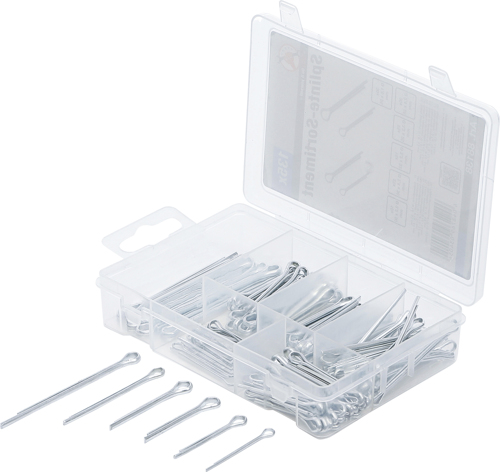
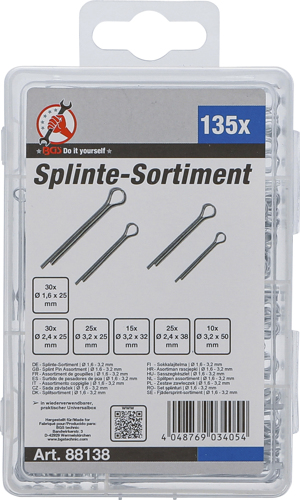
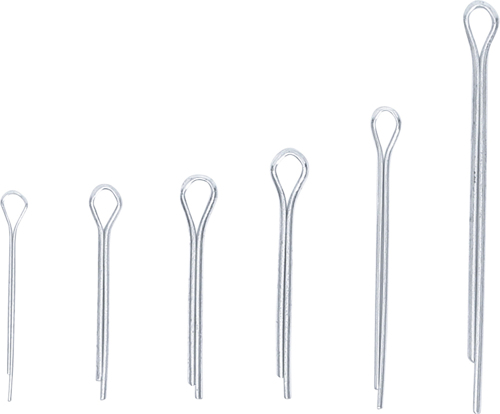
The BGS 135-piece split pin set is an assortment of split pins (cotter pins) packed in a plastic case with compartments, covering the six most common sizes with diameters of Ø 1.6 mm, Ø 2.4 mm and Ø 3.2 mm and lengths of 25, 32, 38 and 50 mm. A split pin is a bent, two-legged locking device that is pushed through a cross hole in a shaft, bolt or pin; its legs are then bent open so that the joint cannot come apart under vibration.
The pins are made of steel and coated with zinc plating (blue passivation). The zinc coating slows corrosion and keeps the pin legs bendable even after longer storage. A split pin is a single-use locking device: a leg that has been bent open once and straightened again is fatigued, so a pin that has been removed is replaced with a new one of the same size.
The assortment is weighted towards short basic sizes: 30 pcs Ø 1.6 x 25 mm, 30 pcs Ø 2.4 x 25 mm, 25 pcs Ø 3.2 x 25 mm, 15 pcs Ø 3.2 x 32 mm, 25 pcs Ø 2.4 x 38 mm and 10 pcs Ø 3.2 x 50 mm. The size designation is made up of the nominal diameter of the pin and the length of the leg, measured from the underside of the pin’s eye to the end of the leg.
The case measures 123 x 81 x 27 mm and the total weight is 154 g, so the set fits in the side pocket of a tool bag or the drawer unit of a service van. The compartments keep the sizes apart, which speeds up choosing the right pin in the field. The BGS 135-piece split pin set covers typical vehicle, trailer and machinery servicing jobs where a castle nut, pin or drawbar is locked mechanically.
Intended use and suitability:
A split pin is used to lock a joint mechanically so that it cannot come undone by itself. The pin does not carry load; it stops the nut or pin from moving out of place.
- Castle nuts: the pin is pushed through the slot in the nut and the cross hole in the bolt, so the nut cannot work loose under vibration. Common applications are steering and suspension components and the bearing housings of drive shafts.
- Pins and bolted joints: a pin fitted to the end of a mounting pin holds it in its hole, for example in implement mounts and towbar pin joints.
- Trailers and agricultural machinery: Ø 3.2 mm pins in 32 and 50 mm lengths suit larger pins and towing equipment.
- Bicycles, mopeds and small machines: Ø 1.6 mm and Ø 2.4 mm pins lock light axles, brake rods and cable fixings.
- Service and repair: the assortment replaces buying individual sizes separately when a dismantled joint needs a new pin on reassembly.
Package contents:
- 30 pcs split pin Ø 1.6 x 25 mm
- 30 pcs split pin Ø 2.4 x 25 mm
- 25 pcs split pin Ø 3.2 x 25 mm
- 15 pcs split pin Ø 3.2 x 32 mm
- 25 pcs split pin Ø 2.4 x 38 mm
- 10 pcs split pin Ø 3.2 x 50 mm
- Plastic case with compartments and hanging hole
Features:
- 135 pins in six sizes: one assortment covers diameters of 1.6–3.2 mm and lengths of 25–50 mm.
- Zinc-plated steel: blue-passivated zinc coating protects against corrosion in damp locations.
- Case with compartments: each size in its own compartment, the lid keeps the pins apart in transport.
- Case dimensions 123 x 81 x 27 mm: fits in a tool bag and a car storage compartment.
- Hangable pack: the case can be mounted on a workshop wall rack.
- Weighted towards short sizes: 85 of the 135 pins are 25 mm long, which matches the most common service jobs.
Technical specifications:
- Number of pieces: 135 pcs.
- Diameters: Ø 1.6 mm, Ø 2.4 mm, Ø 3.2 mm.
- Lengths: 25 mm, 32 mm, 38 mm, 50 mm.
- Material: steel.
- Surface treatment: zinc-plated, blue passivation.
- Size distribution: 30 x 1.6 x 25; 30 x 2.4 x 25; 25 x 3.2 x 25; 15 x 3.2 x 32; 25 x 2.4 x 38; 10 x 3.2 x 50 mm.
- Case: plastic case with compartments, 123 x 81 x 27 mm.
BGS 135-piece split pin set instructions for use:
Choosing the size: Measure the diameter of the cross hole and choose the pin whose nominal diameter is the next size smaller than the hole. The pin should move in the hole without forcing but without significant play. Choose the length so that the pin goes right through and leaves about the hole diameter of leg to bend.
Fitting: Line up a slot in the castle nut with the cross hole in the bolt by tightening the nut forward to the nearest slot that lines up. Push the pin through with the eye against the nut. Bend one leg over the end of the bolt with pliers and the other against the nut or pin. Cut off a leg that is too long with side cutters so that it does not catch.
Removal: Straighten the legs with pliers and pull the pin out by its eye. If a leg has broken off, push the rest through with a drift.
Care: Always fit a new pin after dismantling. Keep the case closed in a dry place so that the zinc coating is not damaged and the sizes do not get mixed up.
Warnings:
- The bent legs are sharp and cut ends are stiff: wear protective gloves and safety glasses when fitting and removing pins.
- A cut leg end can fly off the side cutters; point the cutters away from your face.
- Do not reuse a pin that has already been bent: a fatigued leg can break and the joint can come apart.
- A split pin is a locking device, not a load-bearing part. Do not use it in place of a bolt, pin or rivet.
- The wrong size weakens the locking: a pin that is too thin bends in the hole, and one that is too thick cannot be fitted without damaging the hole.
- Small parts are a choking hazard. Keep the case closed and out of the reach of children and pets.
Frequently asked questions (FAQ):
What sizes does the BGS 135-piece split pin set contain? Six sizes: Ø 1.6 x 25 mm (30 pcs), Ø 2.4 x 25 mm (30 pcs), Ø 3.2 x 25 mm (25 pcs), Ø 3.2 x 32 mm (15 pcs), Ø 2.4 x 38 mm (25 pcs) and Ø 3.2 x 50 mm (10 pcs).
What material are the split pins made of? Steel, with a blue zinc plating. The coating protects against corrosion, but it does not match the durability of stainless steel in constant moisture or a seawater environment.
How do I choose the right split pin size? Choose the diameter to suit the cross hole: the pin should go into the hole without forcing. The length is measured from the underside of the eye, and enough leg must be left outside the hole to bend.
Can a split pin be reused? No. Bending the leg work-hardens the material, and a straightened leg can break. Always use a new pin.
Which way should the legs be bent? The most common way is to bend one leg over the end of the bolt and the other against the side of the nut, so neither leg catches on moving parts.
What is the difference between a split pin and a spring clip? A split pin is a bendable two-legged pin that is locked by opening its legs. A spring clip, or R-clip, is a clip bent from spring steel wire that stays in place by spring force and can be removed quickly.
Recycling instructions:
Used split pins go to metal collection; zinc-plated steel is fine for ordinary scrap metal. Sort the empty plastic case into plastic collection and any cardboard hanging card into carton collection. Cover the sharp leg ends before disposal so that they do not cause puncture wounds during sorting.