

Description
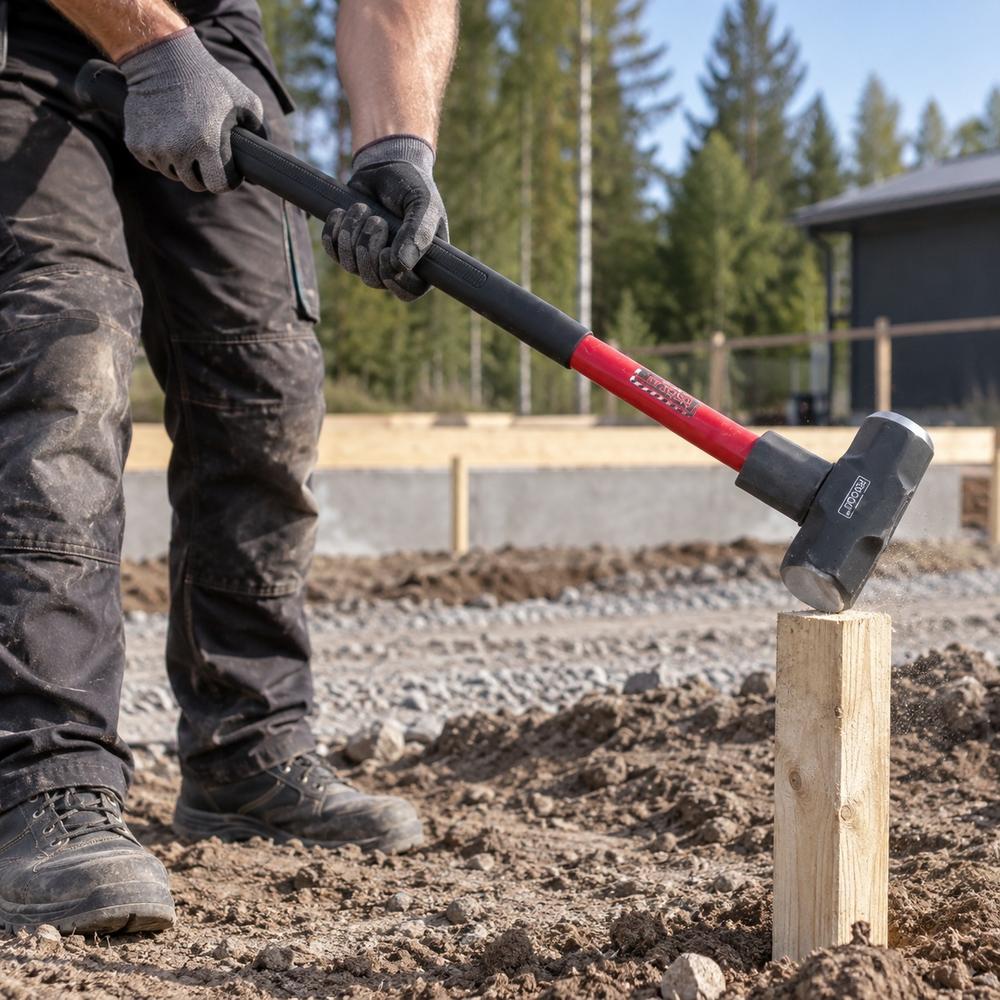
The Procat sledgehammer 3.6 kg fibreglass handle is a long-handled sledgehammer with a steel head weighing 3.6 kg, or 8 lb. The sledgehammer is intended for striking work that needs high kinetic energy in a single blow: breaking concrete and brick, driving stakes and ground pegs, and stripping formwork and structures.
The head is a double-faced solid steel head with two flat striking faces and ground bevels on the edges. The bevels reduce chipping of the edge when a blow lands at an angle. Using both striking faces spreads the wear evenly, so the head keeps its shape longer than when only one face is used.
The handle is fibreglass. A fibreglass handle does not dry out, crack or swell in moisture as a wooden handle does, and it absorbs more of the vibration that returns to the hand from the blow than a solid steel handle. At the top of the handle there is a black rubber guard below the head: it protects the handle from overstrikes, where the workpiece hits the top of the handle, which is the most common point of damage on a sledgehammer.
The lower end of the handle is covered with a ribbed rubber grip that extends about a third of the length of the handle and keeps hold even with wet hands. There is a hanging hole at the end of the handle. The long handle allows a two-handed swing, so the striking speed, and therefore the impact energy, is considerably greater than with a short-handled club hammer of the same head weight.
Intended use and suitability:
A sledgehammer is a striking tool whose power comes from the mass of the head and the tip speed given by the long handle. A head weight of 3.6 kg is in the middle size class of sledgehammers: it breaks lightweight concrete and brick but can still be controlled with a two-handed swing by one person.
- Demolition work: breaking brick walls, lightweight concrete blocks, tiles and concrete structures by hand when a demolition machine cannot fit.
- Driving stakes and posts: ground pegs, fence posts, formwork wedges and tent anchors into the ground.
- Formwork: stripping formwork and driving wedges after concrete casting.
- Groundwork and landscaping: setting kerbstones on their base and driving frost wedges and support stakes.
- Metal structures: freeing seized joints, pins and profiles when a single heavy blow is needed.
Package contents:
- Procat sledgehammer 3.6 kg / 8 lb fibreglass handle, with rubber grip and handle guard
Features:
- Head weight 3.6 kg (8 lb): a mid-size sledgehammer that breaks brick and lightweight concrete but stays controllable with two hands.
- Double-faced solid steel head: two flat striking faces, so wear is spread over both ends.
- Bevelled edges: ground bevels reduce chipping of the edge on angled blows.
- Fibreglass handle: does not dry out, crack or swell in moisture; absorbs vibration compared with wooden and steel handles.
- Handle guard: protects the top of the handle below the head from overstrikes.
- Ribbed rubber grip: a secure grip even with wet hands, covers the lower part of the handle.
- Long handle: allows a two-handed swing and a higher tip speed.
- Hanging hole: at the end of the handle for storage.
Technical specifications:
- Tool type: long-handled sledgehammer.
- Head weight: 3.6 kg (8 lb).
- Head design: double-faced, two flat striking faces, bevelled edges.
- Head material: steel.
- Handle material: fibreglass.
- Handle grip: ribbed rubber coating on the lower part of the handle.
- Handle protection: rubber guard below the head.
- Hanging: hole at the end of the handle.
Procat sledgehammer 3.6 kg / 8 lb fibreglass handle instructions for use:
1. Inspection before use: Check that the head is firmly fixed to the handle and does not move against the wedge. Check the handle for cracks, deep nicks and fraying fibres, and check the condition of the rubber guard. A damaged sledgehammer must not be used: a loose head will fly off.
2. Securing the work area: Make sure there is clear space of at least the length of the swing around and above you. Remove bystanders from the striking area and the path of flying fragments. Check that the ground is firm; swing with both feet on the ground.
3. Grip and swing: Hold the end of the handle with one hand and the other hand closer to the head. Lift the sledgehammer and let the other hand slide down during the swing. Let the mass of the head do the work: strike with relaxed wrists and do not grip the handle convulsively; a stiff grip transmits the vibration of the blow straight into your hand and shoulder.
4. Hitting: Hit the workpiece with the centre of the striking face and as squarely as possible. Angled hits chip the edge of the head and can make the sledgehammer glance off uncontrollably. Change the striking face regularly so that both ends wear evenly.
5. Driving stakes: Start with short, light blows until the stake is upright and firmly in the ground. Only then use a full swing. Check that it is vertical every few blows; a stake that has started off at an angle is not straightened with a side blow.
6. Maintenance and storage: Wipe the head dry after use and remove demolition dust. Store the sledgehammer in a dry place hung from the hole in the handle, not resting on its head on a damp floor. Do not grind the striking face so that its original shape changes; if a burr or chip has formed on the edge, the tool is taken out of use.
Warnings:
- Always wear safety glasses or a face shield: fragments of concrete, brick and metal fly off at high speed.
- Do not strike another hardened steel object, such as another hammer, chisel or axe, with the sledgehammer; hardened surfaces striking each other throw off fragments.
- Check the head fixing before each use. A loose head comes off during the swing.
- Do not use the sledgehammer if the handle has a crack, deep nick or frayed fibres; a damaged fibreglass handle breaks on impact.
- Do not use the handle as a lever and do not strike with the side of the handle.
- Wear protective gloves, safety footwear and ear defenders; loud impact noise and falling pieces cause danger.
- Make sure there are no electricity, water or gas lines in the striking area before breaking structures.
- Repeated striking work loads the shoulders and back; take breaks and use a two-handed grip.
- Keep out of the reach of children.
Frequently asked questions (FAQ):
How heavy is the Procat sledgehammer 3.6 kg fibreglass handle? The head weighs 3.6 kg, or 8 lb. The total weight is higher, because the weight of the handle and grip is added.
What is the difference between a fibreglass handle and a wooden handle? A fibreglass handle does not dry out, crack or swell in moisture, and it absorbs vibration. A wooden handle can be replaced, whereas if a fibreglass handle is damaged, the tool is taken out of use.
What is a 3.6 kg sledgehammer enough for? Breaking brick, lightweight concrete blocks and thin concrete structures, and driving stakes and ground pegs. Demolishing thick reinforced concrete structures needs a heavier sledgehammer or a demolition machine.
Why must you not strike another hammer with a sledgehammer? Both surfaces are hardened steel. When hardened surfaces hit each other, fragments break off the edge and fly off at high speed.
What does the handle guard do? It protects the top of the handle below the head from overstrikes, where the workpiece hits the handle. This is the most common point of damage on a sledgehammer.
Can the sledgehammer be used to drive a ground peg? Yes. Hit the head of the peg squarely with the centre of the striking face and check the condition of the head of the peg: a mushroomed peg head throws off fragments and must be ground or the peg taken out of use.
Recycling instructions:
Cardboard packaging to cardboard collection and any plastic film to plastic collection. A sledgehammer that is no longer used is sorted: the steel head to metal collection and the fibreglass handle with its rubber parts to mixed waste or energy waste, as glass-fibre-reinforced plastic is not recycled as material in household waste streams. If the head cannot be removed from the handle safely, take the whole tool to the metal collection at a waste station, where the materials are separated during processing.


