Description
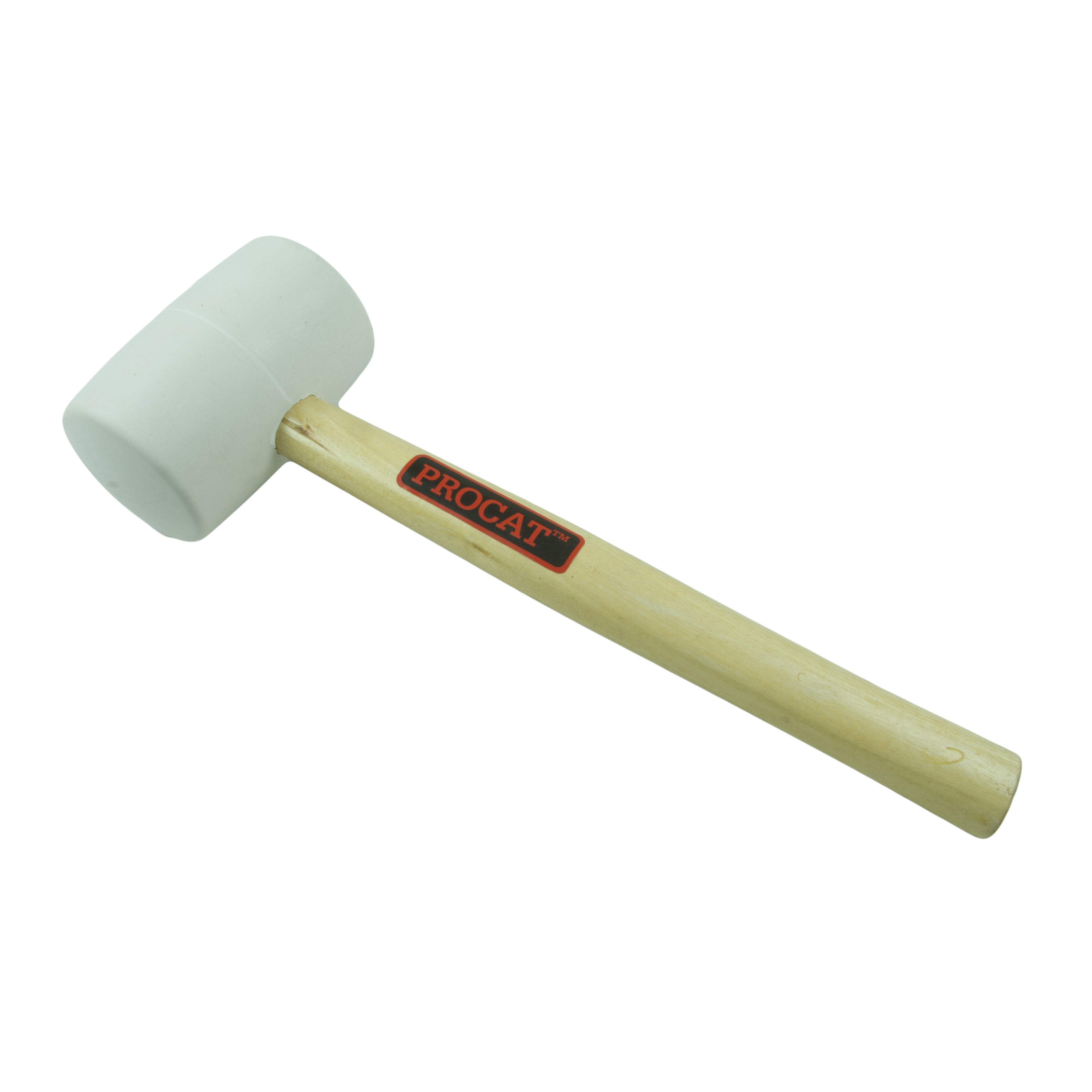
The Schwan rubber mallet 16 oz is an assembly mallet with a white rubber head and a wooden handle that lets you knock parts into place without damaging the struck surface. The head weighs 16 oz, which is about 454 grams.
The head rubber is light-coloured and free of colourants. Black rubber rubs off on impact and leaves a dark mark on a light surface that has to be sanded or washed off; the white, non-marking rubber does not stain the struck surface. This is decisive on light tiles, white mouldings and light parquet, where a mark would remain visible in the finished work.
The cylindrical head has two flat striking faces, which spread the impact force over a wide area. The rubber flexes on impact and lengthens the duration of the blow, so the peak force drops and the part moves without breaking. The same flex dampens the recoil to your hand.
The handle is made of wood and widens towards its end, which keeps your grip in place even with sweaty hands. The fibres of the wooden handle dampen vibration, and the handle can be replaced if it breaks. Wood does not withstand constant moisture: when it gets wet the handle swells, and when it dries it shrinks, which loosens the wedge in the head.
Uses and suitability:
A rubber mallet is used to move, press and align parts that a steel hammer would break or mark. White rubber is the choice when the struck surface stays visible.
- Tiling: pressing tiles into mortar and levelling the tiled surface; white rubber leaves no mark on light tiles or grout.
- Parquet and laminate: knocking the tongue-and-groove joints of boards together via a tapping block or pull bar.
- Mouldings and wooden parts: pressing skirting boards, cover strips and joints into place without dents.
- Assembly: aligning sheet metal parts, plastic housings and coated parts.
- Garden work and paving: setting small paving slabs and kerbstones in a sand bed.
Package contents:
- 1 pcs rubber mallet, white rubber head 16 oz, wooden handle
Features:
- White rubber head: non-marking rubber, does not stain light tiles, mouldings or parquet.
- Head weight 16 oz (approx. 454 g): general-purpose weight for assembly and alignment work.
- Two flat striking faces: spread the impact force over a wide area and reduce point loading.
- Flexible rubber: lengthens the blow, lowers the peak force and dampens recoil to the hand.
- Wooden handle: dampens vibration and can be replaced if needed.
- Flared handle end: keeps your grip in place even with damp hands.
- Wedged fixing: the head is fixed to the handle with a wedge.
Technical specifications:
- Head weight: 16 oz (approx. 454 g).
- Head material: rubber, white, non-marking.
- Head shape: cylinder, two flat striking faces.
- Handle: wood.
- Handle fixing: wedge.
- Application: light-coloured and coated materials where a mark would remain visible.
Schwan rubber mallet 16 oz instructions for use:
Check before use: Check that the handle has no cracks and that the head sits tightly. A loose head comes off on impact. Clean the striking faces: mortar grit or metal swarf stuck to them scratches the struck surface.
Striking: Hold the handle at its thicker end and let the weight of the mallet do the work. Hit the part squarely with the whole striking face; an angled blow loads the edge of the rubber and tears it off. For tiling, use short repeated blows instead of one hard blow.
Protection: When the part is fragile or the surface especially sensitive, strike through a wooden block or pull bar.
Care: Wipe the rubber head after use and remove any mortar stuck to it before it dries. Store in a dry place; damp storage swells the wooden handle and loosens the wedge. If the rubber head is torn or has hardened, the mallet must be taken out of use.
Warnings:
- Do not use the rubber mallet to strike a chisel, cold chisel or nail: the rubber head tears and fragments can fly off.
- Check the head fixing before each use; a loose head comes off on impact.
- Do not use a cracked wooden handle.
- Wear safety glasses; chips come off mortar and tiled surfaces.
- Rubber hardens in frost and can crack, so let the mallet warm up before use.
- Keep out of the reach of children.
Frequently asked questions (FAQ):
Why choose a white rubber head instead of a black one? Black rubber rubs off on impact and leaves a dark mark on a light surface. White rubber without colourants leaves no mark, so it is suitable for light tiles, mouldings and parquet.
How much is 16 oz in grams? 16 ounces is about 454 grams; this is the weight of the head without the handle.
Is a rubber mallet suitable for levelling tiles? Yes. The tile is pressed into the mortar with short repeated blows using the whole striking face. For large tiles, a levelling board is also used so that the pressure is spread.
Can the wooden handle be replaced? Yes. The broken handle is removed from the head, and a suitable hammer handle is fitted in its place and wedged tightly.
Why does the rubber head leave marks even though it is white? Mortar, sand or metal swarf stuck to the striking face scratches the surface. Wipe the striking faces clean before working on light surfaces.
Recycling instructions:
Dismantle a mallet that is no longer used where possible: the wooden handle goes to wood waste or the energy waste fraction, the rubber head to mixed waste or to rubber waste collection according to municipal instructions, and the wedge to metal collection. If the parts cannot be separated, take the whole mallet to mixed waste. Sort cardboard and plastic packaging into their own collections.