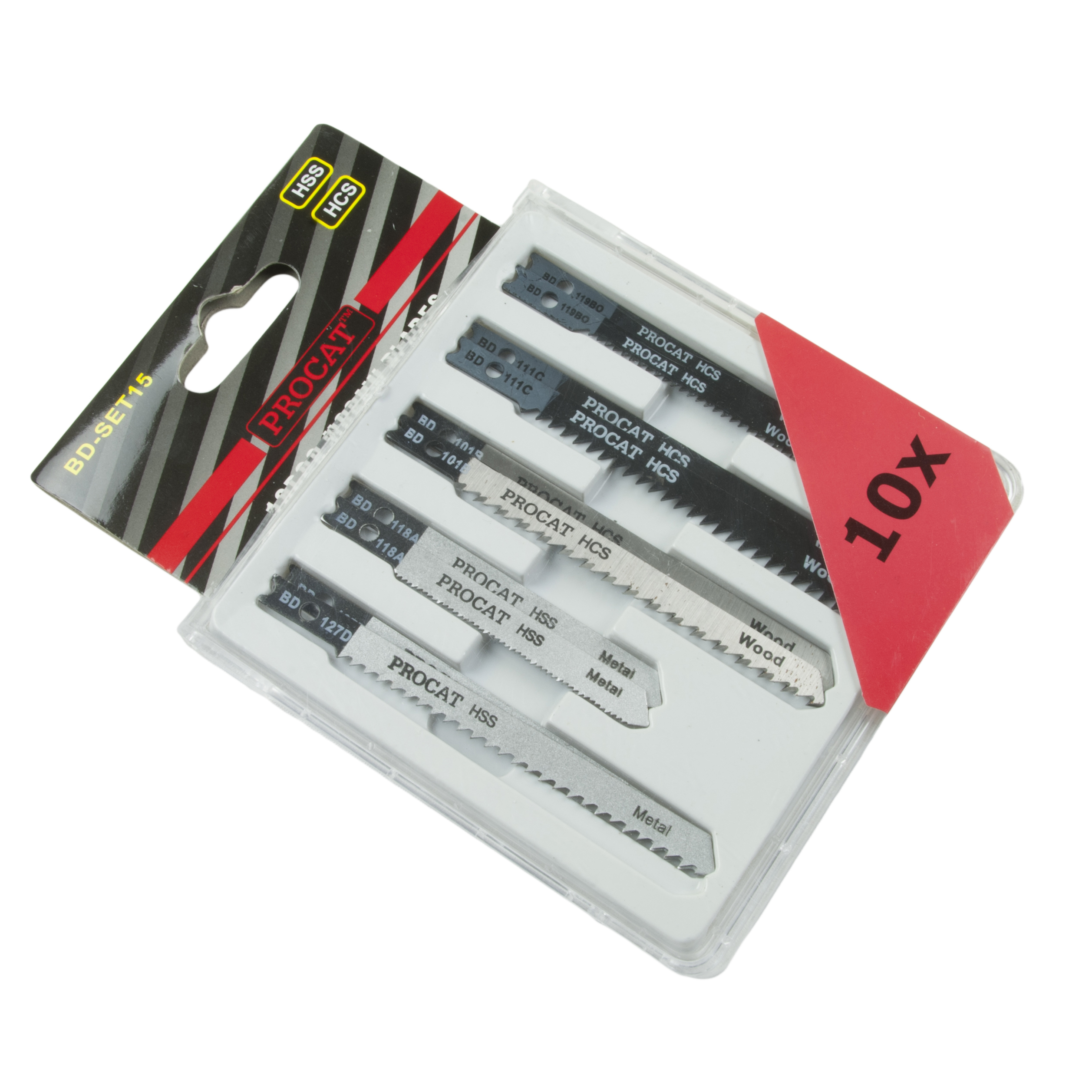

Description
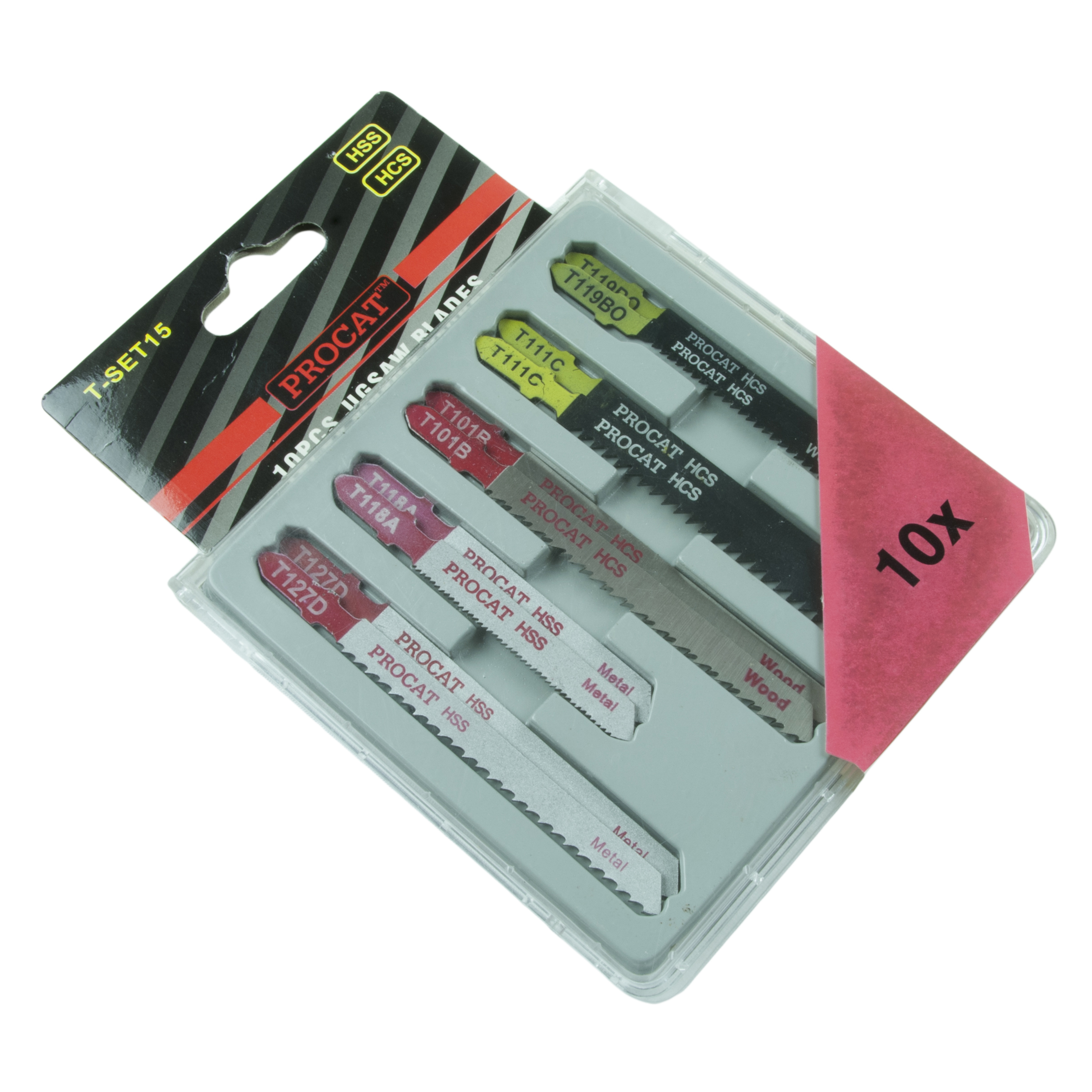
The Procat jigsaw blade set B&D is a mixed selection of 10 blades for jigsaws with a Black & Decker fitting (U-shank). The set covers sawing wood, PVC plastic, aluminium and thin steel sheet, so one pack handles the most common jigsaw jobs without hunting for a blade mid-job.
The set has four blade models that differ in tooth pitch and in the thickness range of the material they work. BD119BO has a tooth pitch of 2.0 mm and is intended for wood and PVC 2–15 mm thick; the narrow blade turns in tight curves. BD101B has a tooth pitch of 2.5 mm and cuts 3–30 mm wood and PVC with a clean cut, so the visible edge does not splinter.
The metal blade BD118A has a tooth pitch of 1.2 mm and is sized for 1–3 mm steel sheet: the fine teeth keep at least two teeth in the sheet at a time and stop the blade catching. BD127D has a tooth pitch of 3.0 mm and is intended for 3–15 mm metal, and for under 30 mm aluminium and PVC; the coarse teeth remove chips efficiently from soft materials (fast cut) and stop the teeth clogging.
The tooth pitch determines the cut finish and speed: a small pitch gives a smooth surface and a slow feed, a large pitch fast sawing and a rougher edge. The U-shank is fixed in the jigsaw blade holder with a screw or a quick-release clamp. Other accessories for the same work stage are the Procat hole saw guide 4-90 mm and the Procat multi-tool blade 34 x 40 mm HCS for wood.
Intended use and suitability:
The set covers the most common jigsaw materials: wood, wood-based boards, PVC, aluminium and thin steel sheet.
- Cutting wood and making openings: BD101B cuts 3–30 mm wood and board with a clean edge, for example sink and tap openings in worktops.
- Curved cuts: BD119BO is narrow and has a tooth pitch of 2.0 mm, so it turns in small-radius curves in 2–15 mm material.
- Thin steel sheet: BD118A with a 1.2 mm tooth pitch saws 1–3 mm sheet metal, profiles and pipe walls.
- Aluminium and plastic: BD127D cuts aluminium under 30 mm and PVC sheet and profile; the 3.0 mm tooth pitch keeps the chip space open.
- Maintenance and demolition work: the mixed selection covers varying materials when the material of the job is not known in advance.
Package contents:
- 10 jigsaw blades with B&D fitting (U-shank)
- BD119BO: wood and PVC 2–15 mm, tooth pitch 2.0 mm
- BD101B: wood and PVC 3–30 mm, tooth pitch 2.5 mm, clean cut
- BD118A: metal 1–3 mm, tooth pitch 1.2 mm
- BD127D: metal 3–15 mm, aluminium under 30 mm and PVC, tooth pitch 3.0 mm, fast cut
Features:
- U-shank: fits jigsaws with a Black & Decker type screw or quick-release fitting.
- Four blade models: wood, PVC, aluminium and steel sheet covered with one pack.
- Tooth pitches 1.2–3.0 mm: the same set gives both a clean and a fast cut.
- Clean cut blade BD101B: the 2.5 mm pitch leaves the edge of the kerf intact on visible surfaces.
- Fast cut blade BD127D: the 3.0 mm pitch removes chips from aluminium and plastic without clogging the teeth.
- Fine metal blade BD118A: the 1.2 mm pitch keeps several teeth in thin sheet and reduces jerking.
- Narrow curve blade BD119BO: small cutting radius in thin wood and plastic.
- 10 blades: worn blades can be replaced mid-job.
Technical specifications:
- Blades: 10 pcs.
- Blade models: 4 (BD119BO, BD101B, BD118A, BD127D).
- Fitting: Black & Decker fitting, U-shank.
- BD119BO: wood and PVC 2–15 mm, tooth pitch 2.0 mm.
- BD101B: wood and PVC 3–30 mm, tooth pitch 2.5 mm, clean cut.
- BD118A: metal 1–3 mm, tooth pitch 1.2 mm.
- BD127D: metal 3–15 mm, aluminium under 30 mm, PVC, tooth pitch 3.0 mm, fast cut.
- Tooth pitch range: 1.2–3.0 mm.
Procat jigsaw blade set B&D instructions for use:
Choosing the blade: Choose the blade according to the material and its thickness. Wood and PVC 3–30 mm: BD101B. Thin wood and plastic or curved cuts 2–15 mm: BD119BO. Steel sheet 1–3 mm: BD118A. Aluminium under 30 mm, thicker metal 3–15 mm and PVC: BD127D. At least two teeth must be engaged in the thickness of the material at a time.
Fitting the blade: Unplug the jigsaw or remove the battery. Place the U-shank in the blade holder with the teeth facing forward and tighten the screw or release the quick-release lever. Check that the blade is straight and the support roller touches the back of the blade.
Sawing: Place the base plate firmly against the workpiece, start the saw and only bring the blade into the workpiece at full speed. Use a high speed for wood and a low speed for metal. Start an internal opening from a drilled hole. When sawing metal, lubricate the cutting line. Do not press the saw; let the blade cut. Too much feed bends the blade and makes the kerf crooked.
Maintenance: Let the blade cool before removing it. Remove chips and resin from the blade and store the blades in a dry place. Replace the blade when cutting slows down, the kerf goes crooked or teeth have chipped.
Warnings:
- Disconnect the jigsaw from the mains or remove the battery before changing the blade.
- The blade heats up when sawing: do not touch it straight after work.
- The teeth are sharp: handle blades by the edges and keep them in the pack.
- Clamp the workpiece. A loose workpiece vibrates and can break the blade.
- The wrong blade or material that is too thin breaks teeth, and fragments fly off. Wear safety glasses.
- Sawing metal produces hot chips, and sawing wood and PVC produces dust: wear safety glasses, gloves and use local extraction or a respirator.
- The blades only fit a blade holder for U-shanks; do not force them into a T-shank fitting.
Frequently asked questions (FAQ):
Which jigsaws do these blades fit? Jigsaws whose blade holder is a Black & Decker type U-shank fitting. The blades do not fit a T-shank fitting.
Which blades are in the set? Four models, 10 blades in total: BD119BO (wood and PVC 2–15 mm), BD101B (wood and PVC 3–30 mm), BD118A (metal 1–3 mm) and BD127D (metal 3–15 mm, aluminium under 30 mm and PVC).
Which blade gives the cleanest cut in wood? The BD101B blade: the 2.5 mm tooth pitch and clean cut teeth leave the edge of the kerf intact in 3–30 mm material.
Which blade is used to saw thin sheet metal? BD118A. The 1.2 mm tooth pitch is sized for 1–3 mm steel sheet, so several teeth stay engaged in the sheet and the blade does not catch.
Can the set saw aluminium? Yes. BD127D is intended for aluminium under 30 mm and 3–15 mm metal; the 3.0 mm tooth pitch keeps the chip space open.
What does tooth pitch mean in practice? The tooth pitch is the distance between two teeth in millimetres. A small pitch (1.2 mm) cuts thin material slowly and smoothly, a large pitch (3.0 mm) cuts thick and soft material quickly and roughly.
Why does the blade go crooked when sawing? The most common reasons are too much feed pressure, a worn blade and material that is too thick for the tooth pitch of the blade. Reduce the pressure and change to a blade suited to the material thickness.
Recycling instructions:
Take used blades to metal collection. Cover the teeth with tape or cardboard, for example, before disposal so that the blade does not cause cuts during sorting. Sort cardboard and plastic packaging into carton and plastic collection according to material. Blades must not be put in mixed waste.