
Description
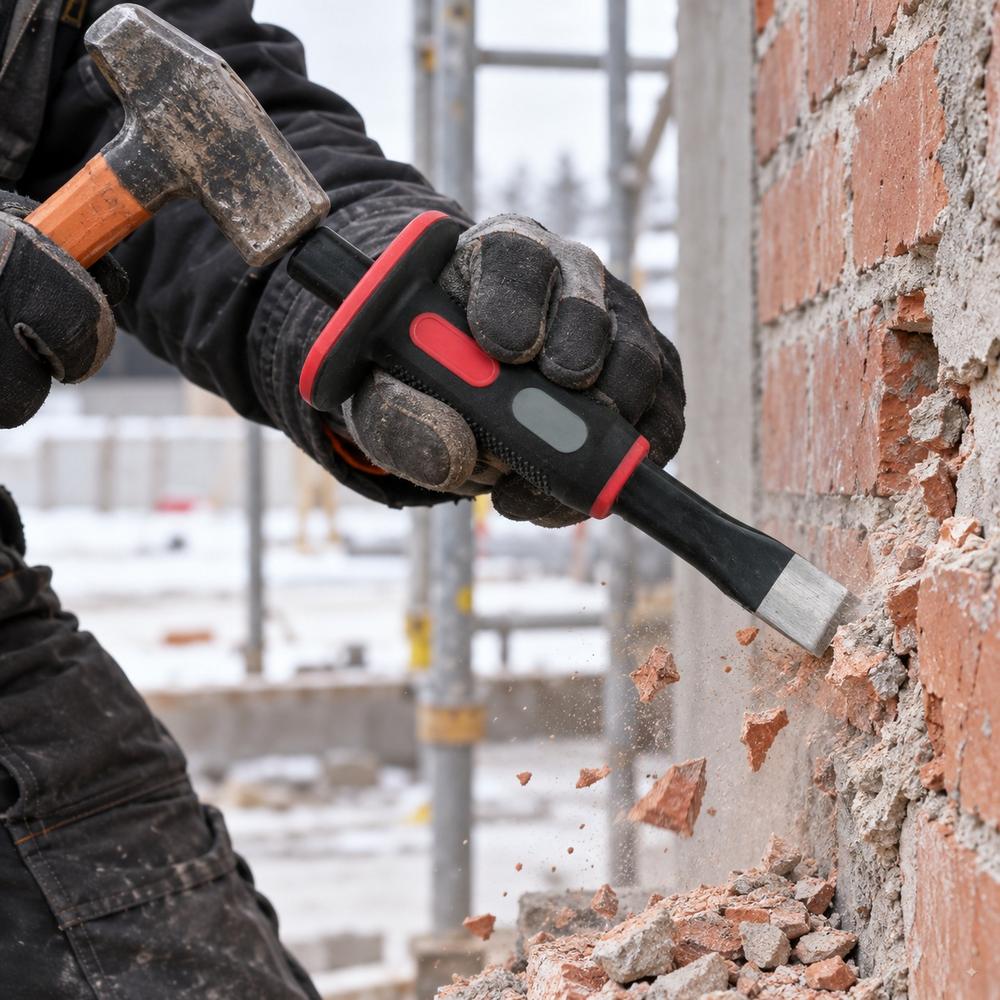
Procat stone chisel with hand guard is a striking chisel for splitting and shaping stone, brick and concrete. The chisel has a steel body with a rubber-coated grip moulded over it and a plate-shaped hand guard above the grip. The striking end stays free above the guard, so the blow of the hammer or club hammer goes straight onto the steel.
The hand guard is the key safety feature of the chisel: it takes a blow that slips past the striking end and keeps the hand out of the line of the blow. The guard has a rubber edge and is wide enough to cover the grip on both sides, which makes it easier to work in tight spots and poor light.
The rubber grip surface of the handle is patterned lengthwise. The coating keeps its grip even with dusty and damp hands and dampens some of the shock of the blow. Below the grip, the body continues in one piece to the blade, so the blow is transferred from the striking end to the blade without intermediate parts.
The chisels come in three sizes: 250 x 25 mm and 400 x 25 mm with a narrow tip, and 250 x 100 mm with a wide tip. A narrow blade concentrates the blow on a small point for chipping and opening grooves, while a wide blade spreads the blow along the whole splitting line when cutting brick and masonry stone.
Intended use and suitability:
The chisel is struck with a hammer or club hammer, so the blade penetrates the stone and splits it. The width of the blade decides whether the blow is concentrated on a point or spread along a line.
- Cutting brick and masonry stone: the wide 100 mm blade is placed on the cutting line and struck once, firmly.
- Chipping concrete and mortar: the narrow 25 mm blade opens a groove, removes old mortar and removes surface screed.
- Shaping natural stone: lightly knocking down an edge and removing excess stone with gradual blows.
- Demolition work in tight spots: the 400 mm long model reaches deeper and keeps the hand further from the work.
Package contents:
- 1 pcs stone chisel with hand guard and rubber grip, selected size
Features:
- Hand guard: the wide rubber-edged guard plate stops a missed blow.
- Rubber grip surface: the patterned coating keeps its grip in dusty conditions and dampens shock.
- One-piece steel body: the force is transferred straight from the striking end to the blade.
- Free striking end: the end above the guard can be ground when its edges start to spread.
- Three sizes: 250 x 25 mm, 400 x 25 mm and 250 x 100 mm.
Technical specifications:
- Body and blade material: steel.
- Handle: rubber-coated, integrated hand guard.
- Sizes (length x blade width): 250 x 25 mm, 400 x 25 mm, 250 x 100 mm.
- Colour: black body, red grip highlights.
- Materials worked: brick, masonry stone, natural stone, concrete.
Procat stone chisel with hand guard instructions for use:
Preparation: Mark the cutting or chipping line. Support the workpiece so that it cannot bounce from the blow. Check that the striking end has no spread or broken edges.
Use: Hold the handle by the rubber grip so that your whole hand stays below the hand guard. Place the blade on the line at a slight angle and strike the striking end squarely with a hammer or club hammer. On a large stone, first make a groove along the whole cutting line with light blows, and only then strike the hard splitting blow.
Maintenance: Clean stone dust off the chisel after use. Grind spread edges off the striking end with a grinder and cool the steel while grinding so that the hardening does not soften. Sharpen the blade to a shallow bevel when it goes blunt.
Warnings:
- Wear safety glasses: stone and steel chips fly off the blow at high speed.
- Wear protective gloves, ear defenders and, if necessary, a respirator because of stone dust.
- Do not strike with a chisel whose striking end is spread or broken, as a fragment coming off is dangerous.
- Take care not to trap your fingers between the hand guard and the workpiece.
- Make sure there are no other people in the area where chips fly.
Frequently asked questions (FAQ):
What is the hand guard for? It stops the club hammer or hammer if the blow misses the striking end, and protects the hand from flying chips.
Which size for cutting brick? The 250 x 100 mm wide-bladed model spreads the blow along the whole cutting line and gives a neater cut than a narrow blade.
Can the chisel be used to chip concrete? Yes. The narrow 25 mm blade is suitable for chipping concrete and removing mortar by hand.
Can the striking end be struck with a club hammer? Yes. The striking end is designed for hammer and club hammer blows; spreading edges are ground off.
How is the blade sharpened? With a grinder to a shallow bevel, cooling the steel often so that the hardening is not affected.
Recycling instructions:
Sort a discarded chisel into metal collection. Remove the rubber and plastic parts where possible and sort them into plastic collection or energy waste according to local instructions.