
Description
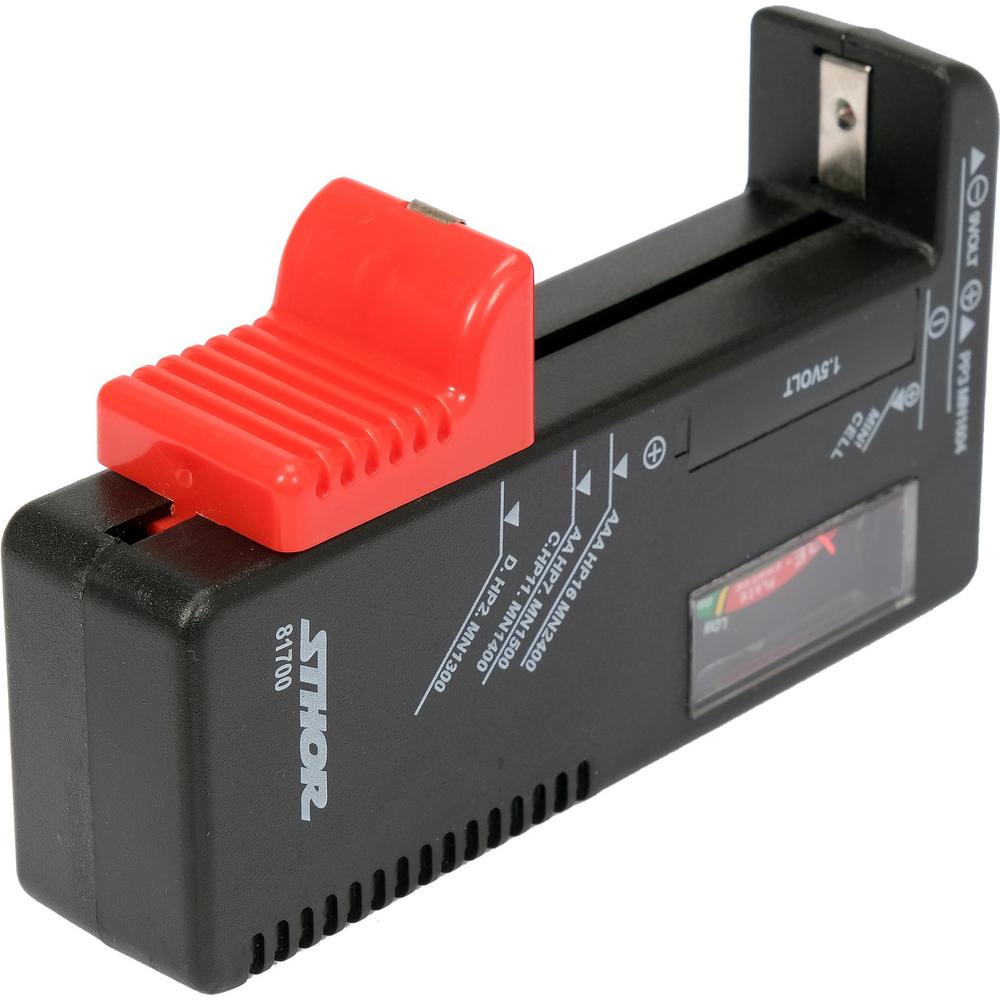
Sthor battery tester analogue 1.5V – 9V is designed for quickly finding out the charge of many kinds of batteries. Its main feature is its ability to measure voltage under an electrical load. This method gives a more accurate and reliable picture of the battery’s real capacity than a basic multimeter. The meter is fully passive: it needs no power source or internal batteries of its own and uses the current of the battery being tested to move the needle.
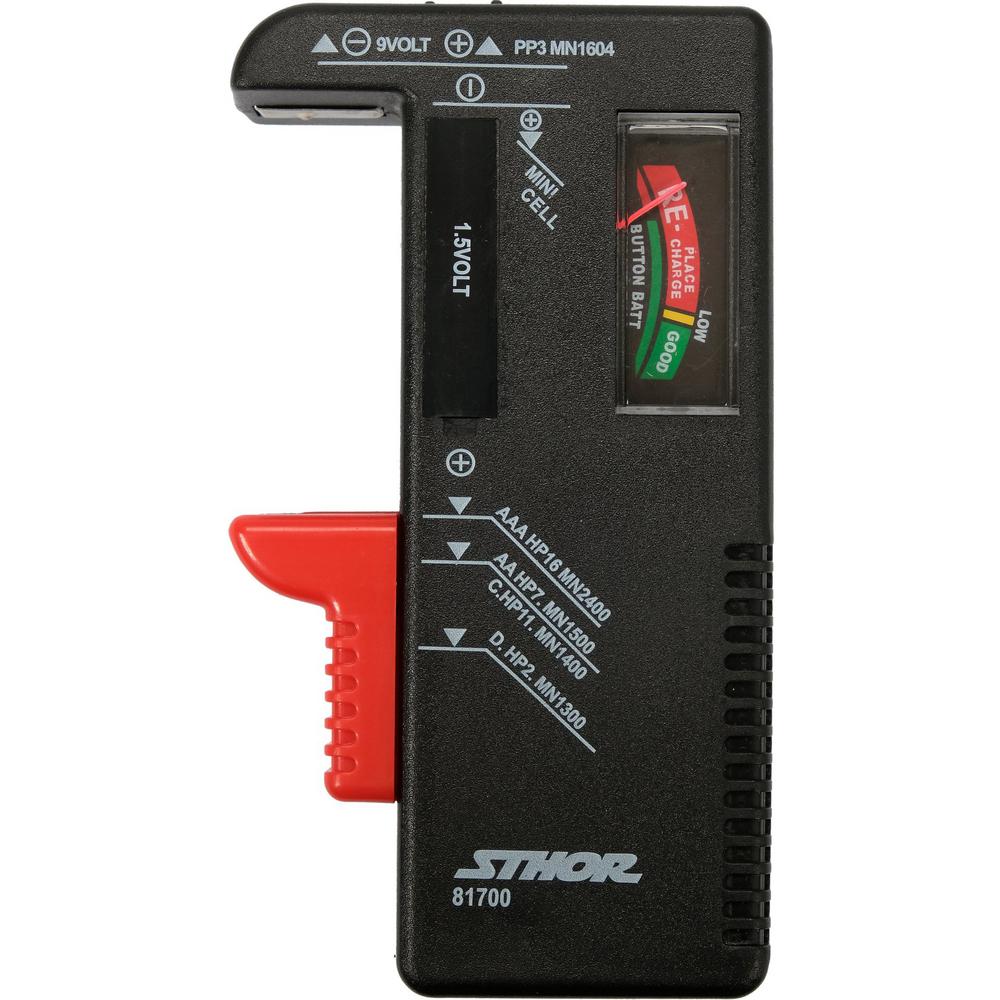
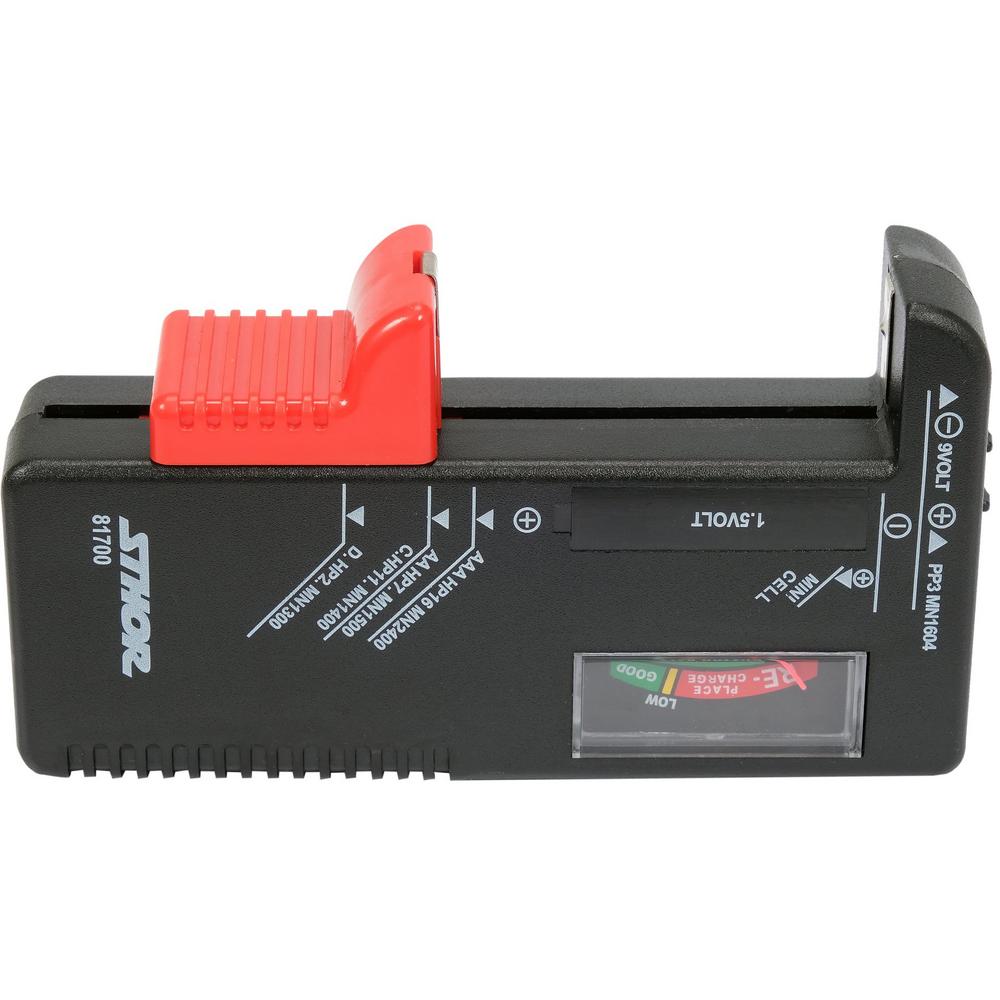
The tester supports a very wide range of the most common battery types on the market. Compatible 1.5 V types include AA, AAA, C and D, along with many other standard sizes (such as LR14, R20, R03). On the 9 V side, the tester easily measures flat 6F22 and PP3 type snap-terminal batteries, among others. The analogue meter gives a continuous, real-time result immediately once electrical contact with the battery is made through the tester’s metal contacts.
The colour-coded scale of the meter is divided into three clear zones for quick reading. The green GOOD zone shows that the battery is fully serviceable. The yellow LOW sector indicates that the charge has dropped significantly. The red REPLACE/RECHARGE zone means that the battery is completely used up. The compact 100 x 60 mm dimensions and weight of only 46 grams ensure that the tester travels easily in a service bag and among your equipment while taking up hardly any space.
Intended use:
- Service and maintenance work: A measuring device for service staff for routine checks and preventive maintenance of batteries in devices such as wireless sensors, smoke alarms and industrial remote controls.
- Quality assurance of materials: Lets you efficiently verify the electrical charge of customer returns, discontinued batches or batteries that have stood in stock for a long time before reuse or disposal.
- Production workstations: A practical diagnostic tool for assembly lines and electrical equipment servicing where many different battery-powered components are handled.
Package contents:
- Sthor battery tester analogue 1.5V – 9V (1 pc)
Features:
- Measurement under load: The meter puts a small load on the battery being tested, which prevents the false positive readings that a conventional voltage measurement typically gives on weak batteries.
- Passive operation: The tester’s analogue pointer mechanism runs purely on the voltage source being measured, making the tester completely maintenance-free and always ready to use.
- Colour-coded analogue display: A scale modelled on traffic lights makes reading the charge smooth, visual and unambiguous, removing the need to interpret numbers.
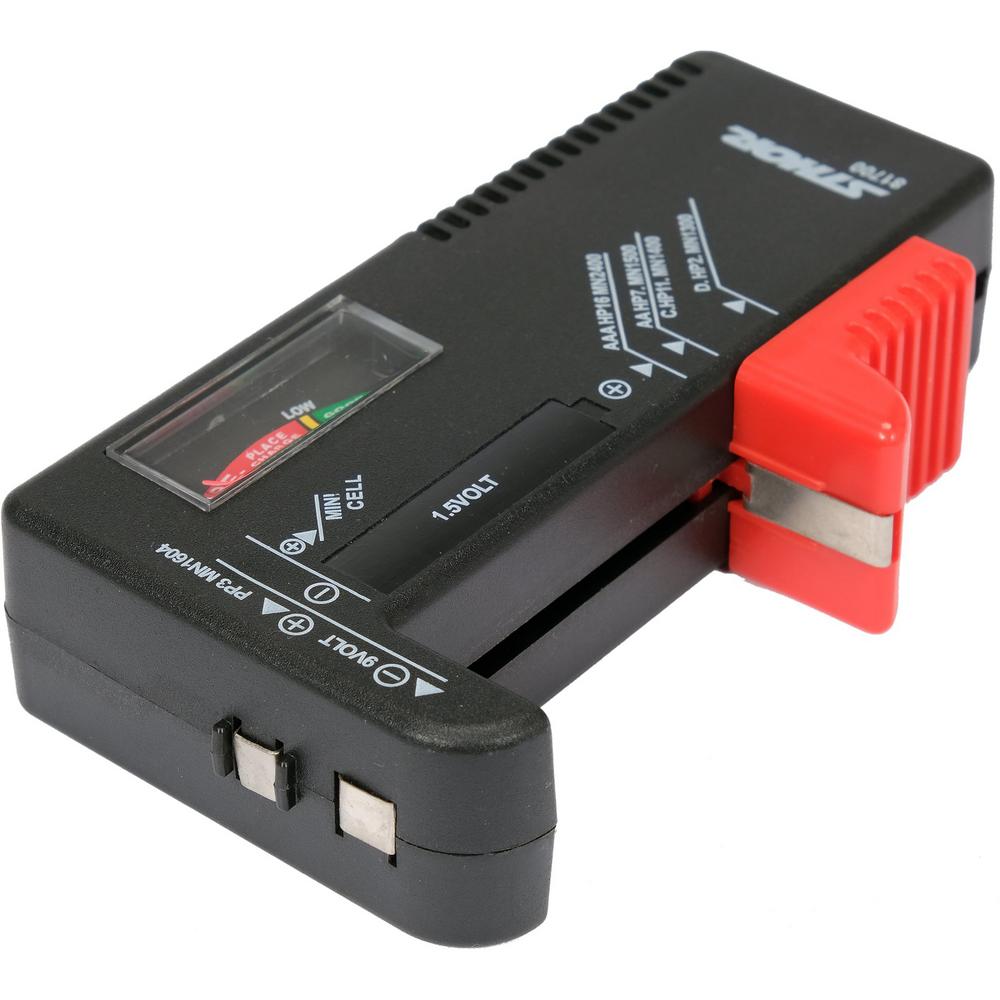
- Adjustable sliding contact: The spring-loaded sliding contact ensures optimal electrical contact with 1.5 V cylindrical batteries of different lengths without separate spacers.
Technical specifications:
- Supported voltages: 1.5 V and 9 V
- Compatibility 1.5V: AA, AAA, C, D, R03, SH16, MN2400, HP7, MN1500, UM3, HP11, MN1400, SO11, LR14, UM2, HP2, MN1399, SP2, R20, UM1
- Compatibility 9V: PP3, MN1604, 6F22, 006P
- Display: Analogue pointer needle
- Dimensions (length x width): 100 mm x 60 mm
- Total weight: 46 g
- Body material: ABS plastic
Sthor battery tester analogue 1.5V – 9V instructions for use:
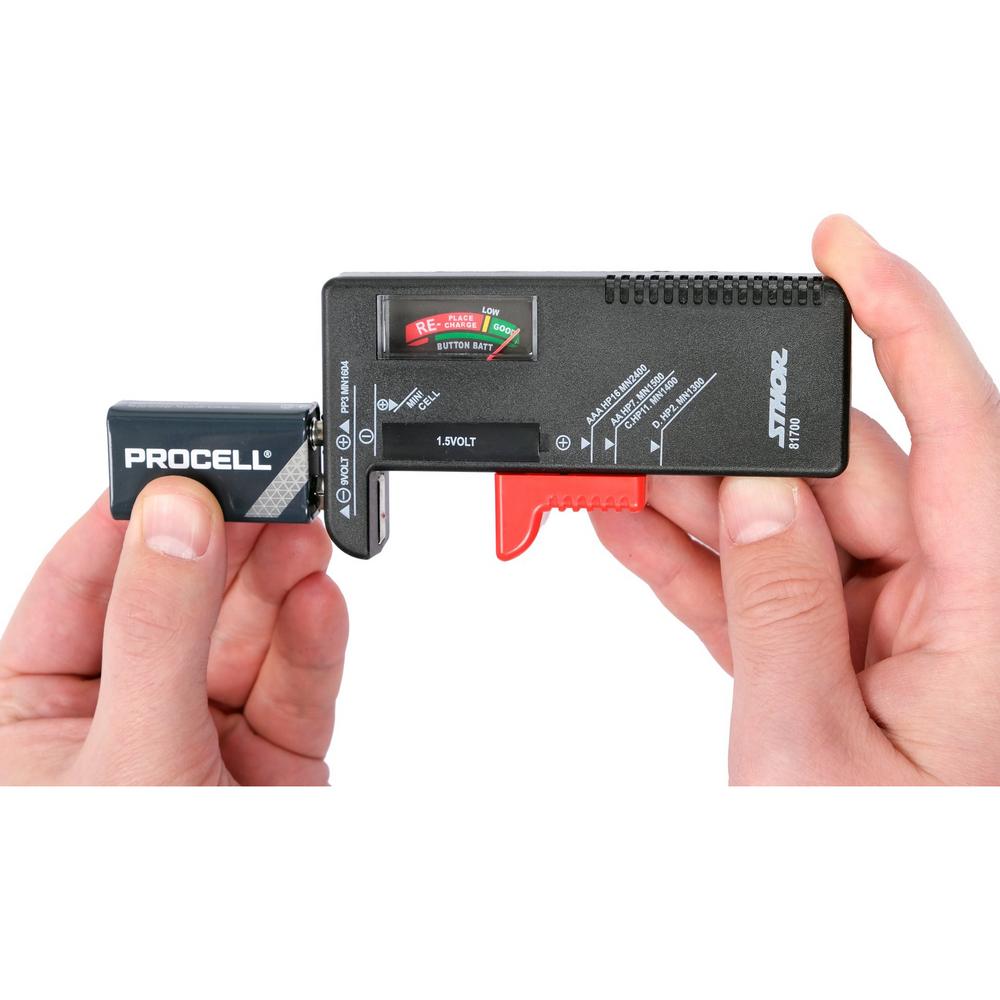
Place the battery to be tested the right way round on the tester contacts. When testing 1.5 V cylindrical batteries, pull back the red sliding contact on the side of the tester, place the battery in the holder according to its polarity and release the sliding contact so that it presses firmly against the battery terminal. 9 V batteries are tested with the separate fixed terminals at the top of the tester, against which the battery is pressed evenly. Read the result immediately from the display according to the coloured zone. Do not hold the battery on the contacts for longer than a few seconds. The meter draws current from the battery during the test to load it, and a long measurement drains the battery being tested unnecessarily. Remove the battery from the tester as soon as you have read the result.
Warnings:
- The tester draws current from the battery to take the measurement. Avoid long measurements of more than 10 seconds so that the battery is not drained needlessly.
- Always make sure the polarity is correct when inserting the battery. Reversed polarity or measuring voltage sources over 9 volts permanently damages the analogue meter.
- Keep the metal contact surfaces of the tester free of dust and moisture. Dirty contacts can distort the voltage reading.
Frequently asked questions (FAQ):
- Can this meter also test rechargeable batteries?: The tester is suitable for a rough estimate of 1.2 V NiMH batteries and rechargeable 9 V batteries too, but the scale markings are optimised primarily for 1.5 V and 9 V primary batteries, so a full reading for a 1.2 V rechargeable battery may sit slightly lower on the display than expected.
- Why does the tester not give a reliable reading for a new battery?: This usually points to poor electrical contact. Make sure the terminals of the battery and the metal contacts of the tester are completely clean and free of oxidation, and check that the polarity is the right way round.
- Does this tester need regular electrical calibration?: No. The meter’s passive analogue coil and needle mechanism is calibrated once at the factory as a fixed part of the movement and needs no servicing afterwards.
Recycling instructions:
The tester is classed as waste electrical and electronic equipment (WEEE), so it must not be disposed of with ordinary municipal or mixed waste. At the end of its life, take the product to a local collection point for electrical equipment, where its ABS plastic parts and internal metal and electronic components can be separated properly for reuse. Packaging materials are usually sorted into cardboard or plastic collection depending on the main material of the wrapping.