

Description
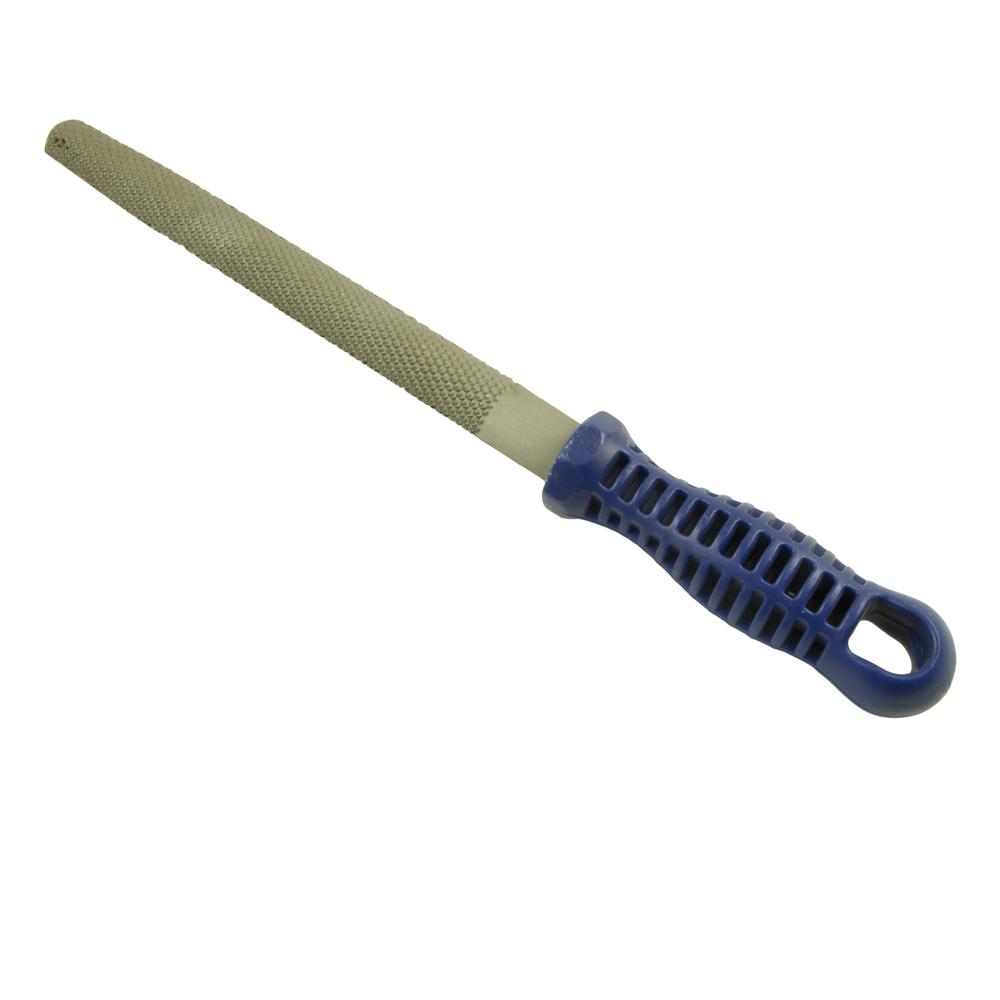
Hase wood rasp with handle is a hand rasp for rough shaping of wood, supplied with the handle fitted. The range has three 200 mm long models that differ in cross-section: flat, half-round and round.
The teeth of the rasp are separate, raised teeth that remove wood in pieces rather than with the continuous ridges of a file. That is why a rasp removes material faster than a file and leaves a rougher surface, which is finished with a file or sandpaper.
The blade is tool steel and the handle plastic. The handle covers the tang of the rasp, so you can press the tool with your palm without the tang digging into your hand. The rasp cuts only on the forward stroke; on the return stroke the rasp is lifted off the surface so that the teeth do not wear unnecessarily.
The difference between the three profiles lies in the shape being worked: the flat one works flat surfaces and outside corners, the round one enlarges holes and works tight inside curves, and the half-round one combines both. Comparable set products are the Narex wood rasp set 200 mm and the Narex wood rasp set 200 mm Fine Cut.
Intended use and suitability:
The rasp is intended for removing wood by hand, when more material is to be removed than with a file but more precisely than with a saw or chisel.
- Rough shaping: rounding chair legs and handles and roughing out a curved basic shape before filing and sanding.
- Fitting joints: fine-tuning mortise and tenon and dovetail joints when a joint is slightly too tight.
- Rounding and chamfering edges: rounding the sharp corners of planks and boards with the flat model.
- Inside curves and holes: the round model enlarges holes and shapes tight inside curves; the curved side of the half-round model does the same job on gentler shapes.
Package contents:
- 1 pcs wood rasp with the selected profile (flat, half-round or round), length 200 mm
- Handle fitted
Features:
- Three cross-sections: flat, half-round and round in the same 200 mm length.
- Separate teeth: raised teeth remove wood in pieces and do not clog as easily in soft wood as the ridges of a file.
- Tool steel blade: the teeth withstand woodworking and keep their shape.
- Handle fitted: covers the tang, so you can press the tool with your palm.
- Forward-stroke cutting: material is removed in a controlled way during the forward stroke.
- Length 200 mm: a general-purpose length that reaches long surfaces and stays controllable in tight spots.
Technical specifications:
- Length: 200 mm (all models).
- Profiles: flat, half-round, round.
- Blade material: tool steel.
- Teeth: rasp cut, separate teeth.
- Handle: plastic, fitted.
- Cutting direction: forward stroke.
- Materials worked: wood and other soft materials.
Hase wood rasp with handle instructions for use:
1. Choosing the model: Choose the profile according to the shape: flat for flat surfaces and outside corners, round for holes and tight inside curves, half-round for both.
2. Clamping the workpiece: Clamp the workpiece in a vice or with a clamp before you start working.
3. Grip: Hold the handle with one hand and guide the tip of the rasp with the fingertips of the other hand.
4. Working: Push the rasp away from you with even pressure. Lift the rasp off the surface for the return stroke. Use the whole length of the rasp so that the teeth wear evenly.
5. Finishing: The rasp leaves a rough finish. Finish the surface with a file and then with sandpaper.
6. Cleaning: Clean the teeth regularly with a file card. Clogged teeth slide over the surface and do not cut.
7. Storage: Store the rasp dry so that the teeth do not touch other tools. Contact with metal blunts the teeth.
Warnings:
- The teeth are sharp and tear skin. Do not run your finger over the teeth.
- Wear safety glasses; working produces sawdust and dust.
- Clamp the workpiece before working. A moving piece guides the rasp onto your hand.
- Check the fixing of the handle before use. A loose handle exposes the tang, which can pierce your palm.
- Do not work metal; metal blunts rasp teeth immediately.
- Wood dust irritates the airways; work in a ventilated space.
Frequently asked questions (FAQ):
What models are in the Hase wood rasp with handle range? Three 200 mm models: flat, half-round and round.
What is the difference between a rasp and a file? A rasp has separate raised teeth that remove wood in pieces and take off material quickly with a rough finish. A file has continuous ridges that leave a finer surface and are also suitable for harder materials.
Which profile should I choose? Flat for flat surfaces and outside corners, round for holes and tight inside curves, half-round for general use: the flat side for flat surfaces and the curved side for inside curves.
Does the rasp cut in both directions? No. The rasp cuts on the forward stroke; it is lifted off the surface for the return stroke.
Can the rasp be sharpened? Sharpening rasp teeth with hand tools is not practically possible; a blunt rasp is replaced with a new one.
How are clogged teeth cleaned? With a file card, brushing in the direction of the teeth.
Can the rasp work materials other than wood? The rasp is intended for wood and other soft materials. Working metal blunts the teeth.
Recycling instructions:
Sort a discarded rasp: the blade into metal collection and a removable plastic handle into plastic collection. If the handle cannot be removed, take the product to metal collection according to local instructions. The cardboard retail packaging and product card belong in cardboard and paper collection.