
Description
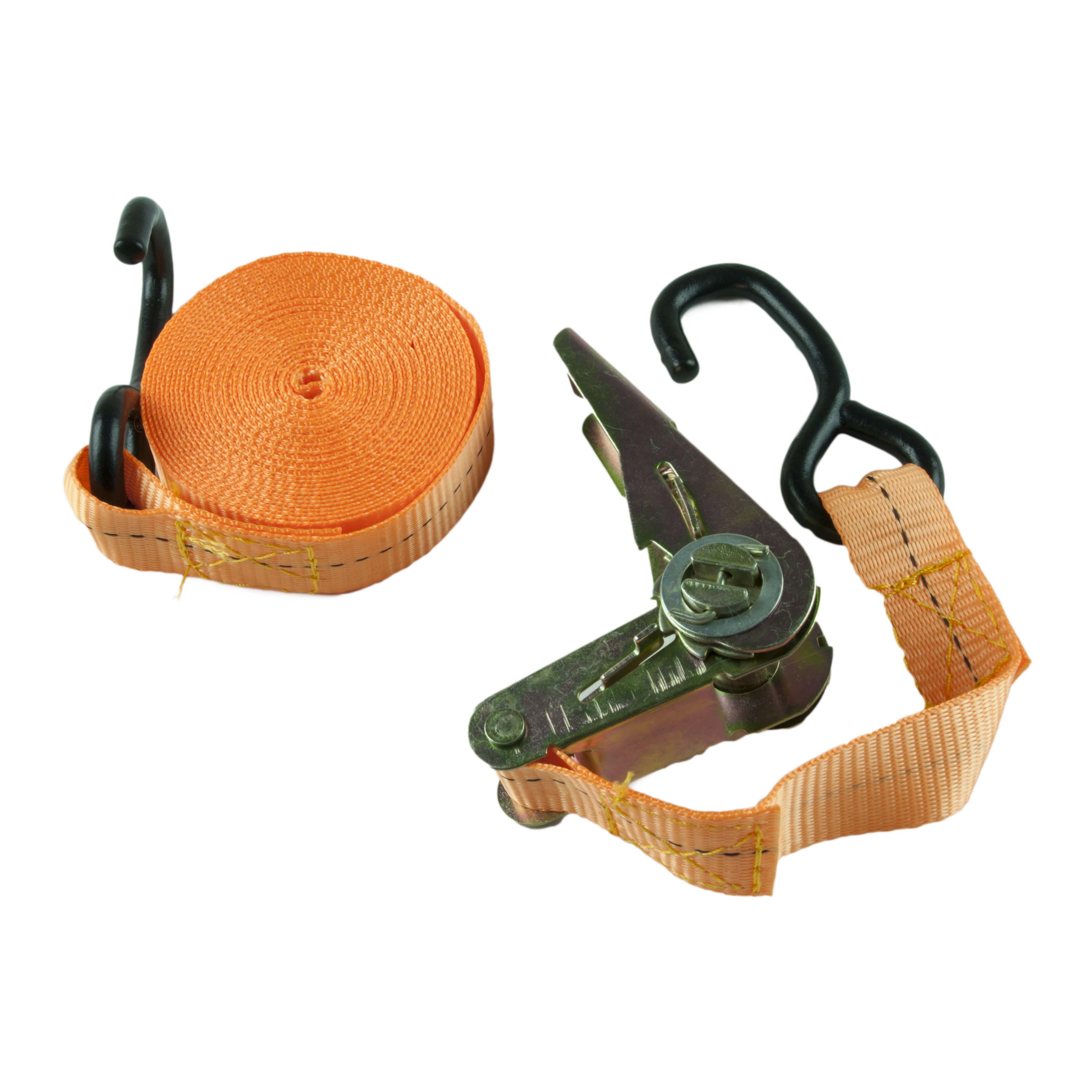
Procat lashing strap 5 m is a set of two ratchet lashing straps with a webbing width of 25 mm and a total strap length of 5 m. Each strap has a lashing capacity of LC 500 daN, a standard tension force of STF 80 daN and a breaking strength of MBS 1000 daN. The straps are certified to EN 12195-2 .
Each strap is made of two parts. The tensioning part has a metal ratchet, a short webbing section and a hook, and the loose end has a long webbing section and a second hook. Both ends have black S-hooksthat attach to the anchor points of a vehicle, trailer or roof rack.
The ratchet works on the lever principle: moving the handle back and forth winds the webbing onto the ratchet spindle and tightens it, and pressing the handle closed locks the tension. The standard tension force STF tells you how much tension the ratchet produces with normal hand force. The lashing capacity LC is the maximum force the strap may be loaded with in a straight pull.
With a lashing capacity of LC 500 daN , the strap is rated for securing light and medium-weight loads, for example on a trailer, in a van or on a roof rack. In friction lashing, where the strap presses the load against the load bed, the number of straps needed is calculated from the standard tension force STF, and in direct lashing from the lashing capacity LC, following the principles of EN 12195-1 . The two straps in the set let you secure the load with two parallel straps.
The lashing strap is intended only for securing loads during transport. The strap is not used for lifting or suspending loads.
Intended use and suitability:
The Procat lashing strap 5 m is suitable for securing light and medium-weight loads on transport vehicles that have anchor points suited to S-hooks.
- Trailer: Securing building materials, boxes, furniture and garden waste bags to the trailer’s anchor points. Two straps tensioned over the load hold it in place when the lashing is sized for the load.
- Van: Securing toolboxes, moving boxes and small machines to the lashing rings in the cargo area.
- Roof rack: Securing light, long items such as boards, mouldings and pipes to the roof rack crossbars.
- ATV: Securing goods to the ATV’s front and rear racks.
- Boat on a trailer: Securing a light boat, such as a rowing boat or canoe, to the trailer frame during transport.
For loads that need a higher lashing capacity, choose the Vorel ratchet strap 4 m 1000/2000daN, and for securing light items without a ratchet, the Procat quick-lock strap.
Package contents:
- 2 pcs lashing straps, 5 m x 25 mm
- Tensioning part on each strap: ratchet, short webbing section and S-hook
- Loose end on each strap: long webbing section and S-hook
Features:
- Ratchet tensioner: The metal ratchet tightens the webbing with a lever action and locks the tension when the handle is pressed closed.
- S-hooks at both ends: The black S-hooks attach to lashing rings, anchor points on the trailer edge and roof rack bars.
- Two-part design: The tensioning part and the loose end are attached on opposite sides of the load, and the strap is tightened with the ratchet.
- Lashing capacity LC 500 daN: The maximum permitted force in a straight pull according to EN 12195-2.
- Standard tension force STF 80 daN: The tension reached with the ratchet using normal hand force, used when sizing friction lashing.
- Breaking strength MBS 1000 daN: The force at which the strap breaks. In use, the strap is loaded to no more than its lashing capacity LC.
- Orange webbing: The webbing colour stands out on top of the load, which makes the straps easier to inspect.
- Set of 2 pcs: Two straps in the same pack for securing the load with two straps.
Technical specifications:
- Length: 5 m
- Webbing width: 25 mm
- Lashing capacity (LC): 500 daN
- Standard tension force (STF): 80 daN
- Breaking strength (MBS): 1000 daN
- Standard: EN 12195-2
- Tensioner: ratchet
- End fittings: S-hook at both ends
- Quantity: 2 pcs
- Webbing colour: orange
Procat lashing strap 5 m instructions for use:
The load is secured according to the principles of EN 12195-1, and the number of straps is sized according to the mass of the load, the friction and the lashing method.
- Inspection: Before each use, check that the label is in place and legible and that the webbing, seams, ratchet and hooks have no cuts, wear, deformation or rust.
- Attachment: Attach the S-hooks of the tensioning part and the loose end to anchor points on opposite sides of the load.
- Threading: Open the ratchet, thread the loose end through the slot in the ratchet spindle from below and pull the webbing taut by hand.
- Straightening: Make sure the webbing is straight and not twisted or knotted. Knots and twists weaken the strap.
- Edge protectors: Place an edge protector between the webbing and the load at every sharp edge.
- Tensioning: Tighten the strap by moving the ratchet handle back and forth by hand. Do not use an extension bar, pipe or other lever.
- Locking: Press the handle closed until the ratchet locks. Check the tension at the start of the journey and during breaks.
- Release: Support the load, release the ratchet by pressing the handle’s locking lever and open the handle fully.
- Storage: Roll up the webbing and store the straps in a dry place out of sunlight.
Warnings:
- Not for lifting: The lashing strap must not be used for lifting or suspending loads.
- Lashing capacity: Do not load the strap beyond its lashing capacity LC 500 daN.
- No extension bars: Tighten the ratchet by hand only. An extension bar overloads the strap and the ratchet.
- No knots: Do not knot the webbing or use a twisted strap.
- Sharp edges: Use edge protectors. A sharp edge can cut the webbing.
- Damaged strap: Take the strap out of use if the webbing has cuts or wear, the seams are damaged, the ratchet or hook is bent, or the label is missing or illegible.
- Releasing the ratchet: Releasing a tensioned strap can set the load in motion. Support the load before releasing the ratchet.
- Repair: Do not repair a damaged strap yourself.
Frequently asked questions (FAQ):
What do LC and STF mean in the technical data of the Procat lashing strap 5 m?
LC (lashing capacity) is the maximum force the strap may be loaded with in a straight pull, here 500 daN. STF (standard tension force) is the tension reached with the ratchet using normal hand force, here 80 daN.
Can a lashing strap be used for lifting?
No. A lashing strap is intended only for securing loads. For lifting, use lifting slings that are manufactured and marked according to the standards for lifting equipment.
What does daN mean?
daN (decanewton) is a unit of force. 1 daN is 10 N, which corresponds to the weight of about one kilogram.
How many straps are needed to secure a load?
The number of straps depends on the mass of the load, the friction and the lashing method, and it is calculated according to EN 12195-1. Friction lashing uses at least two straps so that the load cannot rotate.
What should I do if the strap’s label has worn and become illegible?
Take the strap out of use. Without a legible label, the strap’s lashing capacity cannot be verified.
How do I keep the strap in working condition?
Rinse dirty webbing with water, let it dry before storage, and store the straps in a dry place away from sunlight, chemicals and sharp objects.
Procat lashing strap 5 m recycling instructions:
Sort a strap taken out of use into its parts: take the metal ratchet and S-hooks to metal collection, and sort the webbing according to your local waste advice, usually as mixed waste.
The retail packaging is a blister pack. The cardboard part goes to cardboard collection and the plastic part to plastic collection when the parts can be separated.