
Description
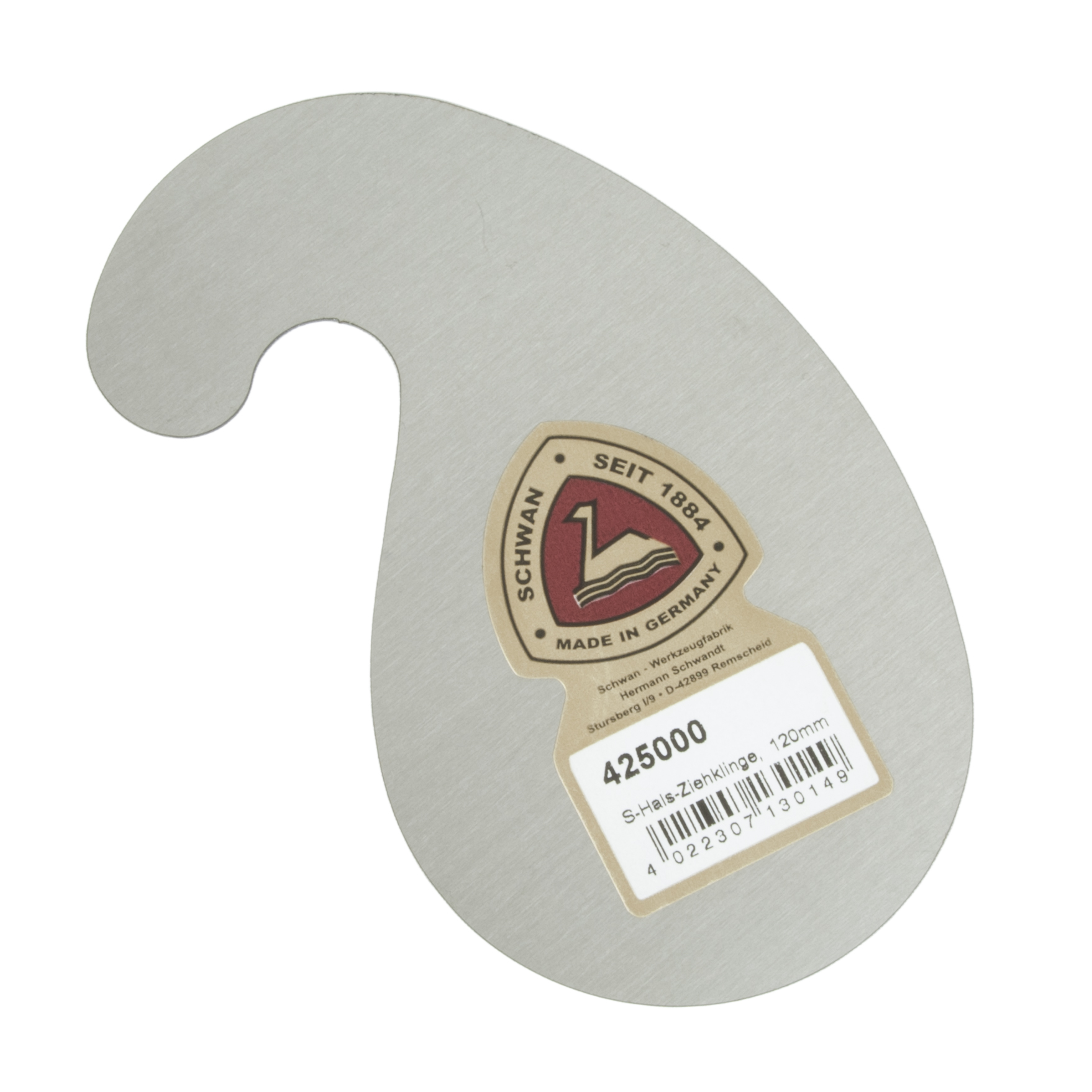
The Schwan gooseneck card scraper is a specialist woodworking tool designed especially for smoothing concave and complex surfaces. Its unique shape, resembling the neck of a swan, offers several different radii and curves in the same tool, which makes it a versatile solution for finishing surfaces. The tool removes fine shavings from the wood surface and leaves a smooth surface without the dust or scratches caused by sandpaper.
The blade of the tool is made of hardened steel, which gives it the necessary hardness and mechanical resistance. The properties of the steel allow a sharp burr to be formed and kept for a long time during work. Hardening ensures that the scraper does not wear prematurely even on hard woods such as oak or walnut, and keeps its cutting ability consistent.
Thanks to its shape, this gooseneck scraper is excellent for places where straight scrapers or power tools cannot follow the shape of the surface. Its different curves are matched to the most common concave shapes found in joinery and restoration. The tool works by shaving the wood fibres, which brings out the natural grain pattern of the wood and gives the surface a bright finish.
The scraper is made using traditional German manufacturing methods, which is reflected in the technical design and finish of the product. It is designed to withstand repeated sharpening and turning of the burr, which significantly extends the life of the tool. The thickness and flexibility of the blade are optimised so that you can control the thickness of the shaving by changing the tilt angle of the tool and the pressure.
In use, the Schwan gooseneck card scraper is an efficient way to remove old varnish, paint or machining marks from curved surfaces. It is an essential part of the tool kit in projects that need geometric precision and perfectly smooth surfaces before finishes are applied.
Intended use:
- Finishing concave surfaces: The primary use of the tool is smoothing concave surfaces such as turned parts, furniture legs and decorative carvings. The gooseneck shape lets you fit the tool into channels and grooves of different sizes, where sanding would be slow or imprecise. Using a scraper ensures that the shape of the surface stays unchanged while the unevenness is removed.
- Restoration and removing old finishes: When restoring old furniture, the scraper is an indispensable aid for removing old finishes from difficult profiles. It lets you scrape off oxidised varnish or paint layer by layer without damaging the wood underneath. Unlike chemical strippers, the scraper allows mechanical, controlled work, which is critical when caring for historically valuable pieces.
- Bringing out the wood grain: The scraper is used as the last step before oiling or waxing, so that the pores of the wood stay open and the grain pattern is as clear as possible. Sanding often clogs the wood grain with fine dust, but the cutting action of the scraper cuts the fibres cleanly. This improves the absorption of the finish and the optical depth of the result.
Package contents:
- 1 x Schwan gooseneck card scraper, hardened steel
Features:
- Gooseneck shape: Several different curve radii in the same blade for versatile work on concave surfaces.
- Hardened steel: Ensures the durability of the blade and allows a precise cutting burr to be turned.
- Versatile profile: Suitable for both deep channels and gentle curves.
- Dust-free work: Produces fine shavings instead of sanding dust, which keeps the working environment cleaner.
- German manufacture: Made to traditional manufacturing standards.
Technical specifications:
- Material: Hardened steel.
- Shape: Gooseneck
- Country of manufacture: Germany.
- Application: Concave and complex wooden surfaces.
- Sharpening: Can be resharpened and the burr turned.
Schwan gooseneck card scraper instructions for use:
Before first use, or when the scraper becomes blunt, the straight edge must be sharpened and a burr turned with a scraper burnisher. Hold the scraper with both hands and tilt it slightly in the direction of travel. Pull or push the scraper along the wood surface in the direction of the grain. Adjust the thickness of the shaving by changing the pressure and the working angle. The scraper may heat up from friction during work, so take breaks when necessary. Clean the blade after use and apply a thin layer of protective oil to prevent rust if the tool will not be used for a long time.
Scraper sharpening and care instructions
The sharpness of a scraper does not come from a traditional ground edge but from a small metal hook turned mechanically on its edge, in other words the burr. When the scraper stops producing fine shavings and starts producing only dust, it must be resharpened.
1. Straightening the edge (filing)
The first step is to remove the old burr and straighten the edge of the scraper.
-
Clamp the scraper firmly in a vice.
-
Use a fine metal file and draw it along the edge of the scraper at an angle of 90 degrees.
-
The aim is a completely straight, flat edge. On a gooseneck scraper, follow the curved shapes of the blade carefully.
-
File until the edge is flat along its whole length.
2. Honing the edge (polishing)
The file leaves a rough surface that must be smoothed before the burr is turned.
-
Use a fine whetstone (e.g. a 1000–4000 grit water or oil stone).
-
Hone the edge of the scraper (90 degrees) and also both sides (faces) against the stone.
-
Continue honing until the edge is mirror-bright and the angle is a sharp 90 degrees. The flatter the edge, the cleaner the shaving.
3. Preparing the edge (drawing out)
Before the actual turning, the steel is “drawn” tight.
-
Place the scraper on a flat surface.
-
Press the burnisher (a hard, polished steel rod) onto the face and draw it towards the edge a few times. This compacts the metal and prepares it for turning.
4. Turning the burr
This is the most critical step, in which the actual cutting edge is formed.
-
Clamp the scraper back in the vice.
-
First hold the burnisher at 90 degrees to the edge and draw it firmly along the edge.
-
On the following strokes, tilt the burnisher slightly (about 5–10 degrees) and draw again.
-
Repeat the stroke 2–3 times with even, firm pressure.
-
Result: A small “hook” that you can feel with your finger has now formed on the edge of the blade, and it cuts wood like a plane.
Points to note with a gooseneck scraper:
A gooseneck scraper is harder to sharpen than a straight scraper, because you have to follow a changing radius. Use shorter strokes when sharpening and make sure the burr turns evenly along the whole curve, so that you can use different parts of the tool on different parts of the workpiece.
Warnings:
The edges of the blade and the turned burr are extremely sharp: handle the product with care to avoid cuts. Always wear safety glasses, as small wood chips may fly off during work. Store the tool protected from moisture to prevent rust. Do not use the tool to work anything other than wood or similar soft materials, so that the hardened steel is not damaged.
Frequently asked questions (FAQ):
How does a gooseneck scraper differ from a straight scraper?
A gooseneck scraper is designed especially for curved and concave surfaces, while a straight scraper is intended for flat surfaces. The gooseneck has several different curves that suit different radii.
How is the scraper sharpened?
The edge of the scraper is first honed straight with a whetstone, after which a small “hook”, the burr, is turned on the edge with a carbide burnisher. This burr does the actual cutting.
Can this be used to remove paint?
Yes, the scraper is excellent for scraping off old paint and varnish, especially from profiled mouldings and curved furniture parts.
Recycling instructions:
The scraper is made of steel and must be disposed of as metal waste.