

Description
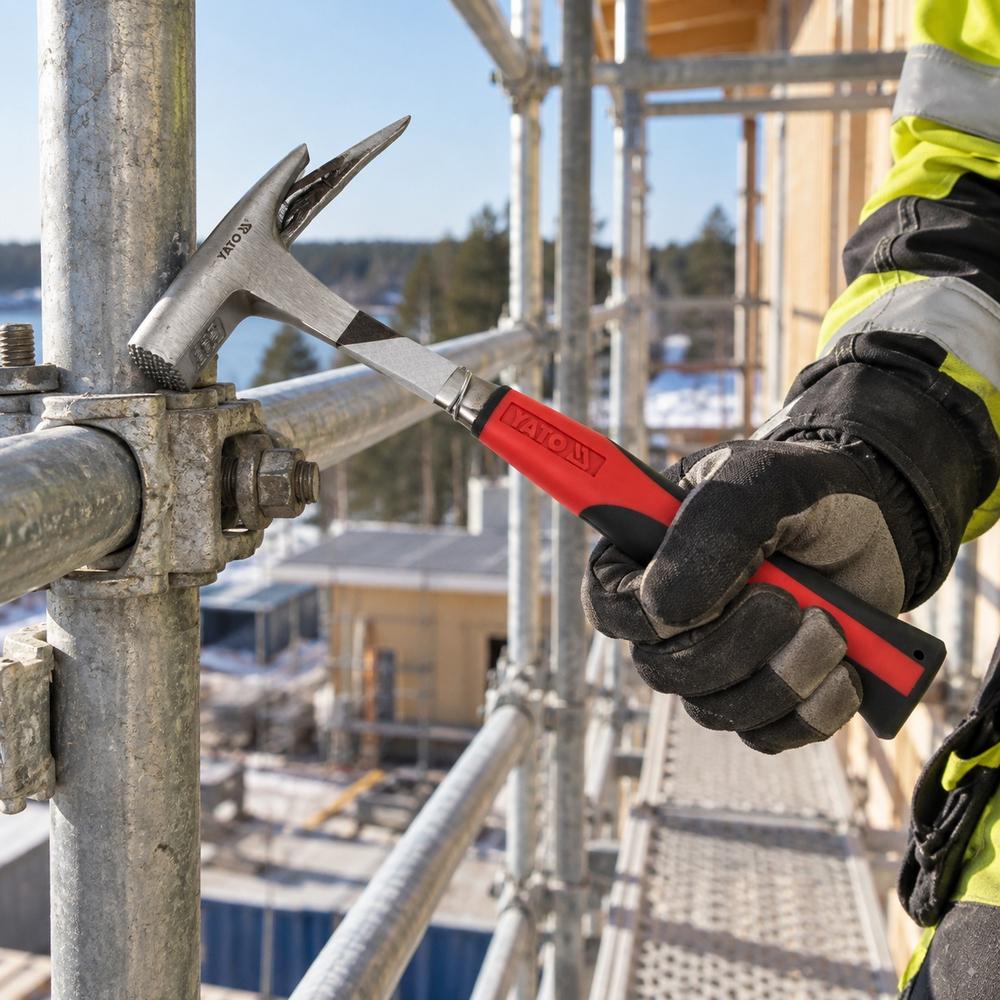
Yato scaffolder’s hammer 600 g is a hammer forged from one-piece carbon steel, with the head and the shaft in one piece. The one-piece construction eliminates the joint between shaft and head, which is the most common point of failure on wooden and tubular-shaft hammers.
On the opposite side of the head there is one sharp spike-type claw. The spike is used to lift and lever out nails, line up the holes of scaffold tube fittings and turn roof battens into place. The spike can also be driven into a timber structure, so the hammer acts as an extra handhold when moving around.
The head is hardened and tempered and the surface polished bright. The head length is 165 mm and the cross-section 25 x 25 mm, the overall length 331 mm and the weight 600 g.
The shaft is coated with TPR rubber and shaped to the hand. The rubber coating damps impact vibration in the hand and keeps a grip when your hands are wet or greasy. Yato scaffolder’s hammer 600 g is suitable for erecting and dismantling scaffolding and for roofing work.
Intended use and suitability:
As well as nailing, a hammer with a spike claw is an aligning and levering tool: the spike lines up holes and opens joints without a separate bar.
- Scaffolding: aligning tubes and fittings with the spike, driving wedges and couplers with the flat face of the head.
- Roofing work: nailing battens and levering battens into place with the spike.
- Demolition work: lifting nails and rivets with the spike, removing boarding.
- Moving on the structure: a spike driven into timber acts as a temporary extra handhold.
Package contents:
- Scaffolder’s hammer 600 g, forged, TPR-coated shaft
Features:
- One-piece forged construction: head and shaft of the same carbon steel, so there is no joint that could loosen or break.
- Hardened and tempered head: withstands blows without chipping and keeps its dimensions.
- Sharp spike claw: lifting nails, aligning holes and levering battens.
- TPR rubber coating: damps vibration and keeps a grip in wet hands.
- 600 g head weight: enough striking force for nailing and driving wedges.
- Surface polished bright: dirt does not stick and dents show during inspection.
Technical specifications:
- Head weight: 600 g.
- Overall length: 331 mm.
- Head length: 165 mm.
- Head cross-section: 25 x 25 mm.
- Material: carbon steel, forged.
- Head treatment: hardened, tempered, polished bright.
- Shaft: steel, TPR rubber coating.
- Claw: one sharp spike.
Yato scaffolder’s hammer 600 g instructions for use:
Nailing: Hold the shaft at the lower end of the coating, so the full length of the lever arm is in use. Start the nail with light blows and then strike from the wrist with the flat centre of the head. Hit the nail head squarely; an angled blow bends the nail.
Aligning: Push the spike into the hole of the scaffold tube fitting and turn the hammer until the holes line up. Lever only in the direction of the spike, not sideways.
Lifting nails: Push the spike under the nail head and tilt the hammer along the shaft. Use a piece of wood to protect the timber so that the spike does not press into the surface.
Maintenance: Check the surface for cracks before use. Wipe the head dry and oil it lightly after the working day. Check that the rubber coating of the shaft is not torn or twisted loose.
Warnings:
- Wear safety glasses: a chip breaking off a hardened surface flies off at impact speed.
- Sharp spike: when moving, carry the hammer in a holster or belt loop, not in a pocket. When working on scaffolding, make sure the spike does not hit another person.
- Do not strike another hammer, a hardened chisel or concrete; hardened surfaces chip when struck against each other.
- Do not use the spike as a lever sideways or as a substitute for a crowbar; the spike bends or breaks.
- Do not use the hammer if the surface has a crack or the rubber coating is torn.
- Keep out of the reach of children.
Frequently asked questions (FAQ):
What is the spike of the Yato scaffolder’s hammer 600 g used for? For lifting nails, aligning the holes of scaffold tube fittings and levering roof battens into place.
What does a forged shaft mean? The head and shaft are forged from one piece of steel, so there is no joint between them that could loosen.
How long is the hammer? The overall length is 331 mm and the head length 165 mm.
Can the hammer be used to strike a chisel? Soft-headed chisels yes, but not hardened stone chisels or another hammer; both surfaces chip.
Is the hammer the same as a roofer’s hammer? The same tool works for roofing: the spike claw levers battens and the flat head nails the batten boarding.
Recycling instructions:
Take a discarded Yato scaffolder’s hammer 600 g to metal collection; the body is entirely steel. The rubber coating can be cut off and sorted into plastic collection, or left in place. Protect the sharp spike before disposal. Put the packaging cardboard in paper collection.