
Description
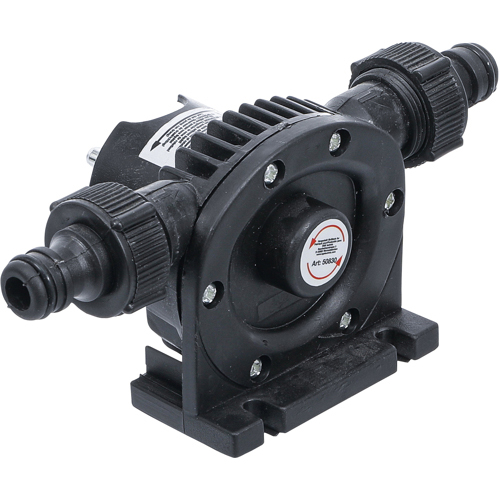
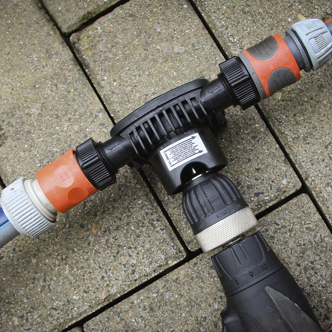
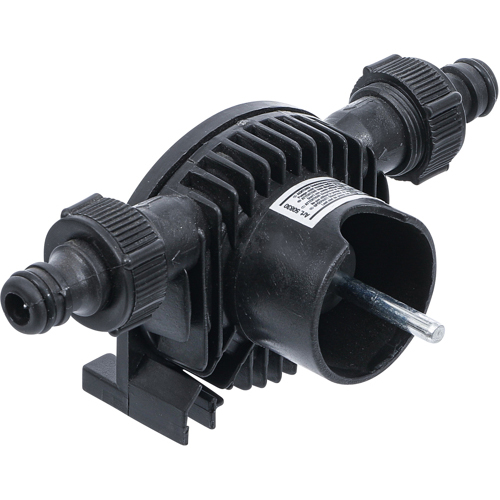
The BGS drill water pump is a mechanical impeller pump driven by an ordinary drill or drill driver. The pump body ends in a 6 mm round shank that is clamped in the drill chuck; the drill’s rotation is transferred directly to the pump impeller. No separate motor, electrical connection or fuel is needed.
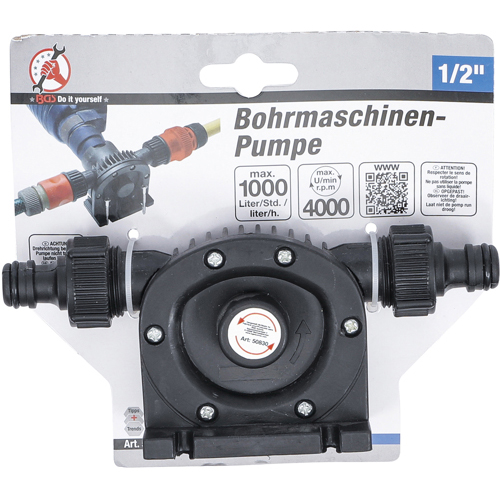
The maximum output is 1000 litres per hour. The output depends on the drill speed, the lift height and the hose length, so in practice the flow rate stays below the nominal value even with short hoses. The maximum permitted drill speed is 4,000 rpm.
The pump has two 1/2 inch hose connections with quick couplings that are compatible with the most common garden hose quick-coupling systems. Hoses connect and disconnect without tools, so switching between suction and pressure sides is quick. The pump is reversible: the flow direction is set by the drill’s direction of rotation, so you change the direction with the drill’s forward/reverse switch.
The body is plastic and the internal parts are metal. The pump is intended for clean water and water-based solutions; fuels, solvents, corrosive liquids and sandy water must not be pumped.
Intended use and suitability:
The pump is intended for occasional water transfer in places where there is no fixed electric pump but a drill is available.
- Emptying tanks and barrels: emptying a rain barrel, irrigation tank or pond without a fixed pump; at the nominal flow rate, 1000 l/h empties a 200 litre barrel in about 12 minutes.
- Garden watering: transferring water from a tank to a garden hose or watering cans; the quick couplings let you change hoses without tools.
- Garage and service work: flushing cooling systems and heat exchangers with water and transferring wash water.
- Removing shallow water: transferring clean water that has collected on a basement floor or in a trench; place the end of the suction hose at the lowest point.
- Aquariums and ponds: changing water and emptying, when the liquid is clean and free of sand.
Package contents:
- BGS drill water pump, 6 mm shank
- 2 pcs 1/2″ quick couplings fitted to the pump
Features:
- Drill-driven: needs no electrical connection or motor; the drive comes from the drill chuck.
- Output 1000 l/h: enough for transferring water from barrels, ponds and shallow water.
- 6 mm round shank: fits all drills whose chuck opens to 6 mm.
- 1/2″ quick couplings: connect and disconnect the hose without tools, compatible with the most common garden hoses.
- Reversible operation: change the flow direction with the drill’s forward/reverse switch.
- Plastic body and metal internals: a lightweight construction that does not rust on the outside.
- Compact size 130 × 60 × 85 mm: fits in a tool bag and a car boot.
Technical specifications:
- Maximum output: 1000 l/h.
- Method of use: drill, 6 mm round shank.
- Maximum drill speed: 4,000 rpm.
- Hose connections: 2 x 1/2″ quick coupling.
- Flow direction: reversible, set by the direction of rotation.
- Body material: plastic.
- Internals: metal.
- Dimensions: about 130 × 60 × 85 mm.
- Liquids that can be pumped: clean water and water-based solutions.
BGS drill water pump instructions for use:
1. Fitting to the drill: Disconnect the drill from the power supply or remove the battery. Open the chuck, push the pump’s 6 mm shank all the way in and tighten the chuck evenly. Check that the pump turns in the chuck without wobbling.
2. Connecting the hoses: Connect the suction hose to the suction side of the pump and the outlet hose to the pressure side with the quick couplings. Make sure the couplings click into place and the hoses are undamaged. Put the end of the suction hose deep enough in the liquid that it stays below the surface throughout the job.
3. Starting: Choose the drill’s direction of rotation according to the flow direction you want. Start the drill at low speed and only increase the speed once water has filled the pump and the flow is steady. Controlled flow is achieved at low speed.
4. During use: Hold the drill with both hands and make sure the suction hose does not draw in air. Running dry heats up and damages the impeller and seals within a few seconds.
5. Finishing and maintenance: Stop the drill before disconnecting the hoses. Flush the pump with clean water if the liquid transferred contained detergent or solids. Drain the water from the pump and hoses and let them dry before storage; water left in the pump freezes in winter and splits the body.
Storage: Store the pump in a dry, frost-free place with the hoses disconnected.
Warnings:
- For water and water-based solutions only. Do not pump fuels, solvents, oils, acids, alkalis or other corrosive or flammable liquids.
- Do not let the pump run dry. Running dry heats the impeller and seals and damages the pump.
- Do not exceed a drill speed of 4,000 rpm. Overspeed breaks the pump body and can throw out parts.
- Disconnect the drill from the power supply or remove the battery before fitting and removing the pump.
- Wear safety glasses: a connection can come loose under pressure and spray water.
- Do not use the pump in a swimming pool or other water where there are people or animals.
- Power tools and water: keep the drill, extension cable and connections dry and use a socket protected by a residual current device.
- Sand, mud and solids wear the impeller. Filter dirty water or use a submersible pump made for the purpose.
- The pump is not suitable for continuous use or for high-pressure systems.
Frequently asked questions (FAQ):
How much water does the BGS drill water pump move? The maximum output is 1000 litres per hour. The actual flow rate depends on the drill speed, the lift height and the hose length.
What kind of drill do I need? A drill whose chuck opens to 6 mm, with a forward/reverse switch and variable speed. The maximum permitted speed is 4,000 rpm; it is best to start at low speed.
Does the pump work with a cordless drill? Yes. The speed and torque of a cordless drill are enough when the drill is fully charged and the speed is kept within the pump’s permitted limits.
Can the flow direction be changed? Yes. The pump is reversible, and the flow direction is set by the drill’s direction of rotation.
Is the pump suitable for liquids other than water? No. The pump is intended for clean water and water-based solutions. Fuels, solvents and corrosive liquids damage the seals and cause a fire and health hazard.
What happens if the pump runs dry? The impeller and seals heat up from friction within a few seconds and are permanently damaged. Make sure the suction hose stays below the surface of the liquid.
Can the pump empty flood water from a basement? Yes, if the water is clean and the end of the suction hose reaches into the liquid. Water containing mud and solids needs a dirty-water submersible pump.
Recycling instructions:
A pump at the end of its life is a product containing mixed small metal and plastic. Take it to metal collection or the municipal recycling point for small items; the plastic body is not separated if there are metal parts inside. The product has no electrical components, so it does not belong in electrical and electronic waste collection. Cardboard packaging goes to carton collection and the plastic bag to plastic collection. Empty and dry the pump before disposal.