
Description
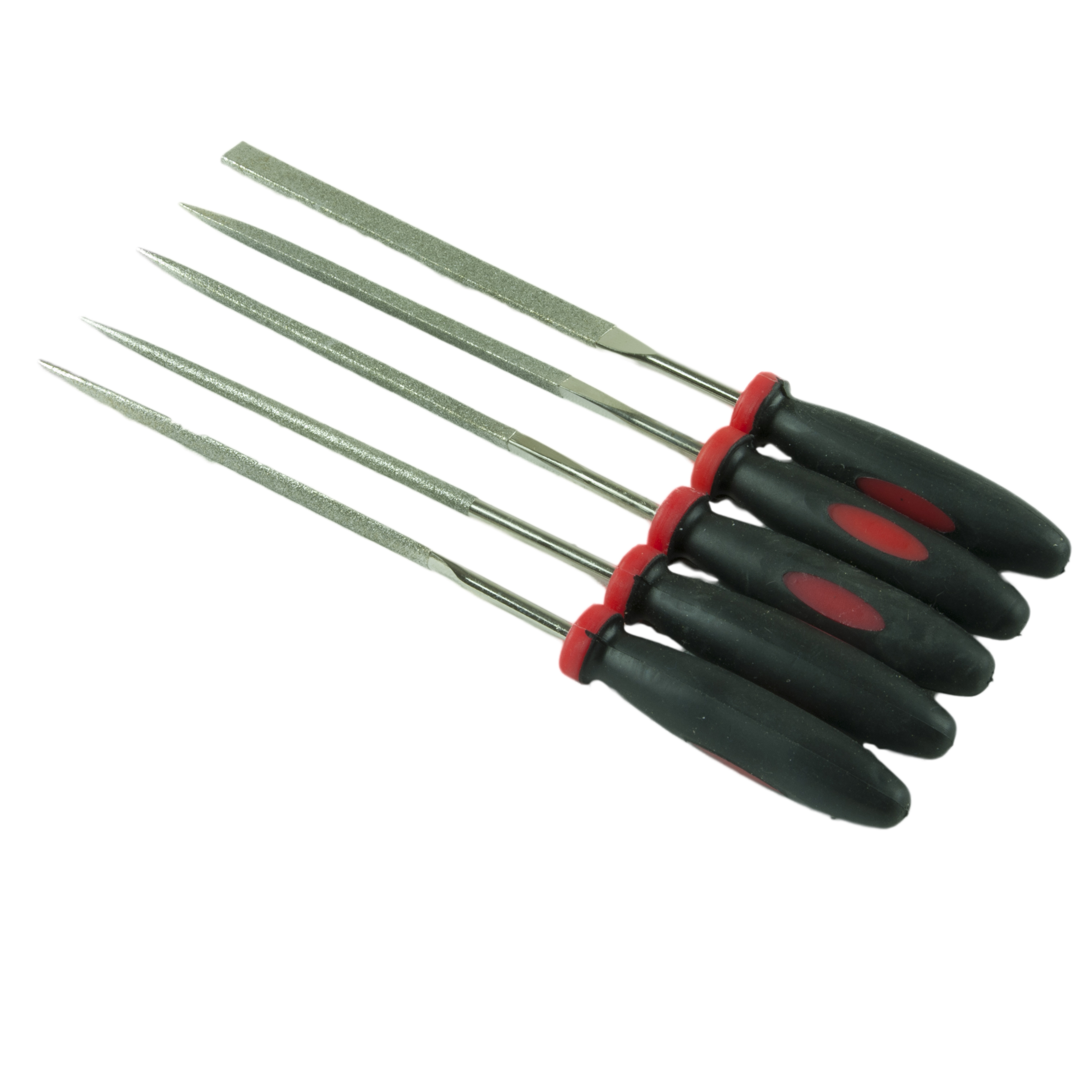
Procat diamond file set 150 mm contains five needle files of different shapes with a diamond-grit working surface. Diamond grit grinds materials that a toothed steel file cannot work: hardened steel, ceramics, glass, carbide and hardwood.
The difference from a steel file lies in the working principle. A toothed file cuts chips with its teeth, and the teeth round off against hard material within a few strokes. On a diamond surface, the grains are held in a bonding agent in random orientations, and each grain scratches its own groove. That is why the Procat diamond file set 150 mm keeps its cutting performance on materials that would blunt a steel file.
The five profiles in the set cover the basic shapes of needle file work: flat for surfaces and straight edges, round for holes and internal curves, triangular for sharp internal corners, square for right-angled grooves and feather-edge for tapering and asymmetric spots. Changing the shape replaces twisting the tool: the right profile reaches the spot as it is.
The files have two-component plastic handles with a soft grip surface over a hard core. The handle matters on a needle file: without it, the thin shank presses into the fingertip in precision work, where the strokes are short and repetitive.
Intended use and suitability:
Needle files are used to work small surfaces, grooves, holes and corners that an ordinary file cannot reach. The diamond surface extends their use to hard and brittle materials.
- Hard metal: finishing hardened steel and carbide, deburring and fitting machined parts.
- Glass and ceramics: cleaning up cut edges, smoothing small chips, fine-tuning grooves.
- Jewellery and precious metal work: finishing stone settings and bezels in small dimensions.
- Precision mechanics: fitting housings and components in confined spaces.
- Hardwood and plastic: fine-tuning joints and details on scale models.
Package contents:
- 1 pcs flat diamond file
- 1 pcs round diamond file
- 1 pcs triangular diamond file
- 1 pcs square file
- 1 pcs feather-edge diamond file
Features:
- Diamond-grit working surface: works hardened steel, carbide, ceramics and glass, which blunt a toothed file.
- Five profiles: flat, round, triangular, square and feather-edge, one tool for each basic shape.
- 150 mm length: controllable with one hand, reaches tight spots.
- Two-component handle: hard core and soft grip surface, supports the fingertip during short strokes.
- No teeth to sharpen: the cutting performance lasts as long as the grains stay on the surface.
Technical specifications:
- Files: 5 pcs.
- Profiles: flat, round, triangular, square, feather-edge.
- Length: 150 mm.
- Working surface: diamond grit.
- Shank: steel.
- Handle: two-component plastic.
- Suitable materials: hardened steel, carbide, ceramics, glass, hardwood, plastic.
Procat diamond file set 150 mm 5-piece instructions for use:
Selection: Flat file for flat surfaces and straight edges, round for holes and internal curves, triangular for sharp internal corners, square for right-angled grooves, feather-edge for tapering and asymmetric spots.
Filing: Clamp the workpiece and clean off loose debris. Stroke the file in one direction with light pressure. Do not saw back and forth, because the return stroke wears the diamond surface and removes no material.
Pressure: Use light pressure even on hard materials. Heavy pressure tears grains out of the bond and shortens the service life.
Cleaning: Remove clogging with a brass brush or compressed air during work. A clogged surface slides instead of grinding.
Wet working: Water keeps the surface clean and binds dust. Dry the files thoroughly immediately after use to prevent corrosion.
Storage: In a dry, dust-free place, with the files kept apart so that the diamond surfaces do not rub against each other.
Warnings:
- Wear safety glasses, as sharp particles come off metal, glass and ceramics.
- Wear gloves; the diamond surface quickly abrades skin.
- Wear a respirator or work wet: ceramic, glass and metal dust is harmful to inhale.
- Do not use the file as a lever, as the thin shank breaks and flies off.
- Do not work soft metals: they clog the diamond surface permanently.
- Keep out of the reach of children.
Frequently asked questions (FAQ):
What materials does the Procat diamond file set 150 mm work? Hardened steel, carbide, ceramics, glass, hardwood and plastic. Soft metals clog the surface.
Why does the file no longer grind? The surface is probably clogged. Brush it with a brass brush; if the performance does not return, the grains are worn and the file is replaced.
Can a diamond file be sharpened? No. The working surface is not toothed, so it cannot be sharpened; the tool is replaced when the grains are worn.
Why is the file stroked in one direction only? The return stroke wears the grains without removing material and can tear grains out of the bond.
Which profile is used for what? Flat for flat surfaces, round for holes, triangular for internal corners, square for right-angled grooves and feather-edge for tapering shapes.
Recycling instructions:
Sort the shanks of discarded files into metal collection and the plastic handles into plastic collection or the energy fraction according to local instructions. If the handle cannot be removed, take the tool to metal collection. Recycle the plastic part of the blister pack as plastic and the backing card in cardboard collection.