
Description
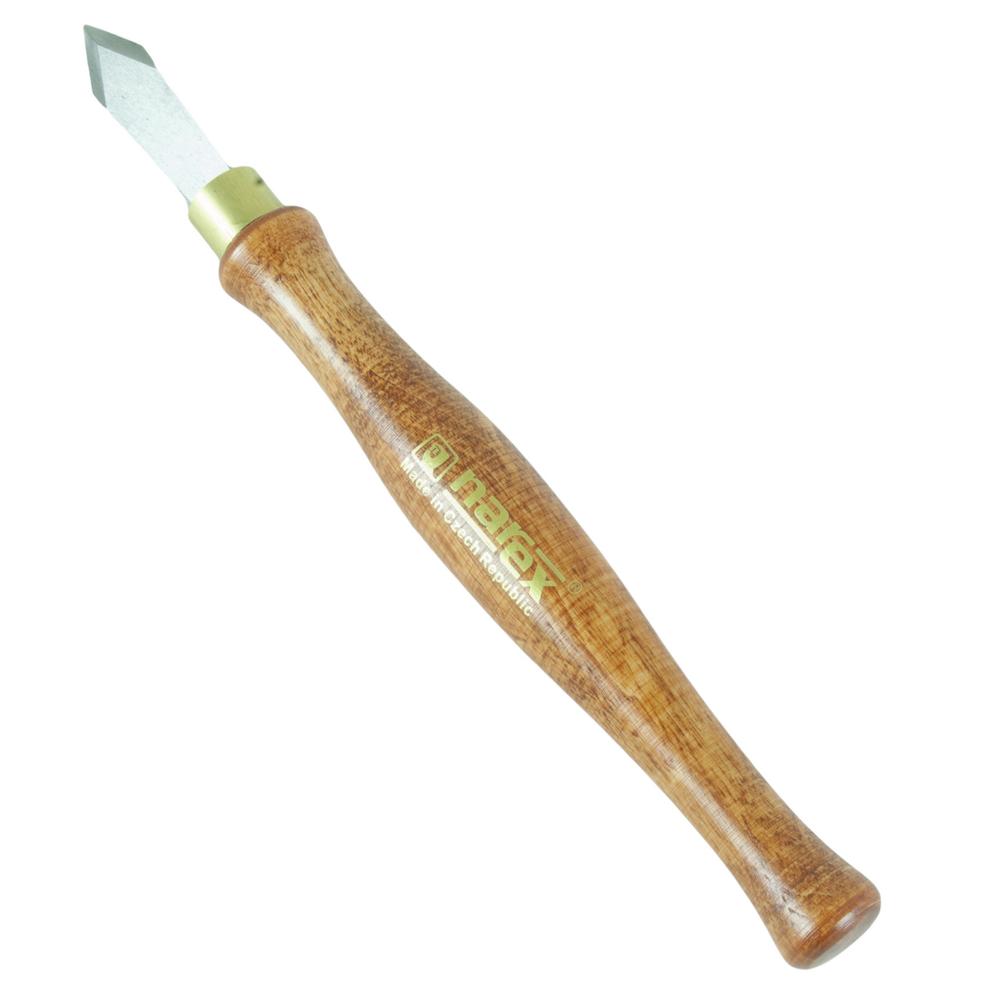
Narex marking knife is a traditional, precise tool designed especially for severing wood fibres across and along the grain at the marking stage. Unlike a pencil line, the cut left by the knife’s hardened steel severs the wood fibres at the surface, which stops the wood tearing during the actual sawing or chiselling. The blade of the product measures 37 x 10 x 1.5 mm and is made of high-quality steel with a hardness of 60HRc. This guarantees excellent edge retention and lets you leave a very fine, sharp line even in hardwoods.
The ergonomic handle of the knife is made of stained and lacquered hornbeam, which gives a sturdy, comfortable grip. The handle is shaped to stop the knife turning in the hand, which is critical when creating precisely defined lines in complex joints such as dovetails. The flat profile of the blade lets you place it right against the edge of a rule or template, which completely removes offset errors in the marking and makes the result dimensionally accurate.
The groove left by the Nare marking knife is deep and narrow enough to act as an anchor for the tip of a chisel. This technical feature speeds up the work and improves quality, as the chisel automatically settles in the right place without fumbling. The durable construction and precisely sharpened tip make this tool an essential part of the kit for all jobs that call for fine surface finishing and perfectly fitting wood joints.
Intended use:
- Precise marking of wood joints: When the marking knife is used to lay out finger or dovetail joints, for example, the knife severs the wood fibres exactly where you want. This stops the grain from lifting and tearing during working. The groove left by the knife acts as a physical guide for the saw blade or chisel, which ensures tight, visually flawless joints. This method is superior to traditional pencil marking, as it takes the structure of the material into account and gives a precise stop for the tool tip in all demanding joinery where accuracy is of prime importance.
- Positioning chisel work: Before chisel work such as hinge recesses or mortise and tenon joints, the marking knife creates a clear, deep boundary groove. This groove ensures that the edge of the chisel finds the right place with the very first blow, stopping the tool from sliding past the mark. The deep cut makes sure the side of the chisel does not crumble the wood outside the mark, which is essential for a neat, precise recess in furniture making and other precision installation work where a neat result is a requirement.
- Cutting veneer and thin materials: The 60HRc hardness and sharp tip of the knife are also excellent for cutting veneer and other thin wood materials. It gives a cleaner cut than ordinary utility knives, as the blade is shaped specifically for cleanly severing wood fibres. This lets you cut complex patterns and straight lines without splitting or breaking the material, which makes it a versatile tool in decorative woodwork and surface finishing, where delicate handling of the material is central.
Package contents:
- 1 x Narex marking knife (37x10x1.5 mm blade) with stained hornbeam handle
Features:
- High hardness (60HRc): The blade stays sharp for an exceptionally long time, even when working hardwoods.
- Precision-ground tip: Leaves a narrow, clearly defined line that is suitable for anchoring the tip of a chisel.
- Hornbeam handle: A durable, close-grained material that gives an excellent balance and feel for the work.
- Severing fibres: Prevents the surface wood from tearing and splintering during working by severing the fibres before mechanical working.
- Compact blade size: The 37 x 10 mm size gives access to awkward corners and narrow spots when laying out joints.
Technical specifications:
- Blade material: High-quality carbon steel
- Blade hardness: 60 HRc
- Blade dimensions: 37 x 10 x 1.5 mm
- Handle material: Stained and lacquered hornbeam (hornbeam)
Narex marking knife instructions for use:
Place the knife perpendicular to the marking line or tilted slightly against it. Use a steel rule or try square as a guide. Draw the knife lightly along the surface to sever the surface fibres. If necessary, make a second pass to deepen the groove if you are using a chisel in the next stage. Clean the blade after use and protect it with a little oil if needed to prevent oxidation. Sharpen the blade regularly on a fine stone so that the marking line stays as thin and precise as possible.
Warnings:
- The blade is extremely sharp; handle and store the knife carefully to avoid cuts.
- Do not use the knife as a lever or to twist material, as the high hardness (60HRc) makes the blade brittle under sideways stress.
- Keep the tool out of the reach of children and pets because of its small size and sharpness.
Frequently asked questions (FAQ):
Question: Can the blade be sharpened on an ordinary sharpening stone?
Answer: Yes, we recommend a fine diamond or water stone to maintain the 60HRc hardness and optimal sharpness.
Question: Why is a knife better than a pencil for marking?
Answer: The knife makes a physical groove in the fibres, in which the chisel or saw blade settles precisely. A pencil line is always thick and hides the actual measuring point.
Question: Is the knife suitable for use on hard fine woods?
Answer: Yes, the 60HRc hardness is designed precisely to keep the edge sharp even when marking dense fine woods such as oak or walnut.
Recycling instructions:
The wooden handle can be disposed of as wood waste. Take the steel part to metal collection. Sort packaging materials into the corresponding collection points (plastic/cardboard).