Description
The Procat hacksaw Hobby 12″ is a hand hacksaw for cutting metal and plastic. The saw frame takes a 300 mm (12″) standard-length hacksaw blade, which the user can easily replace. A blade with 24 TPI teeth is supplied.
The frame is metal and the handle plastic. The metal frame carries the blade tension: the blade is tightened with the screw tensioner at the end of the frame, which pulls the blade straight between the frame pins. A tensioned blade cuts a straight kerf, while a slack blade bends during the sawing stroke and twists in the kerf.
A tooth pitch of 24 TPI means 24 teeth per inch. The fine teeth always keep at least three teeth in the kerf, even when sawing thin material, so a tooth does not catch on the edge of the material and break off. This tooth pitch suits thin metal profiles, pipes, threaded rods and hard plastics.
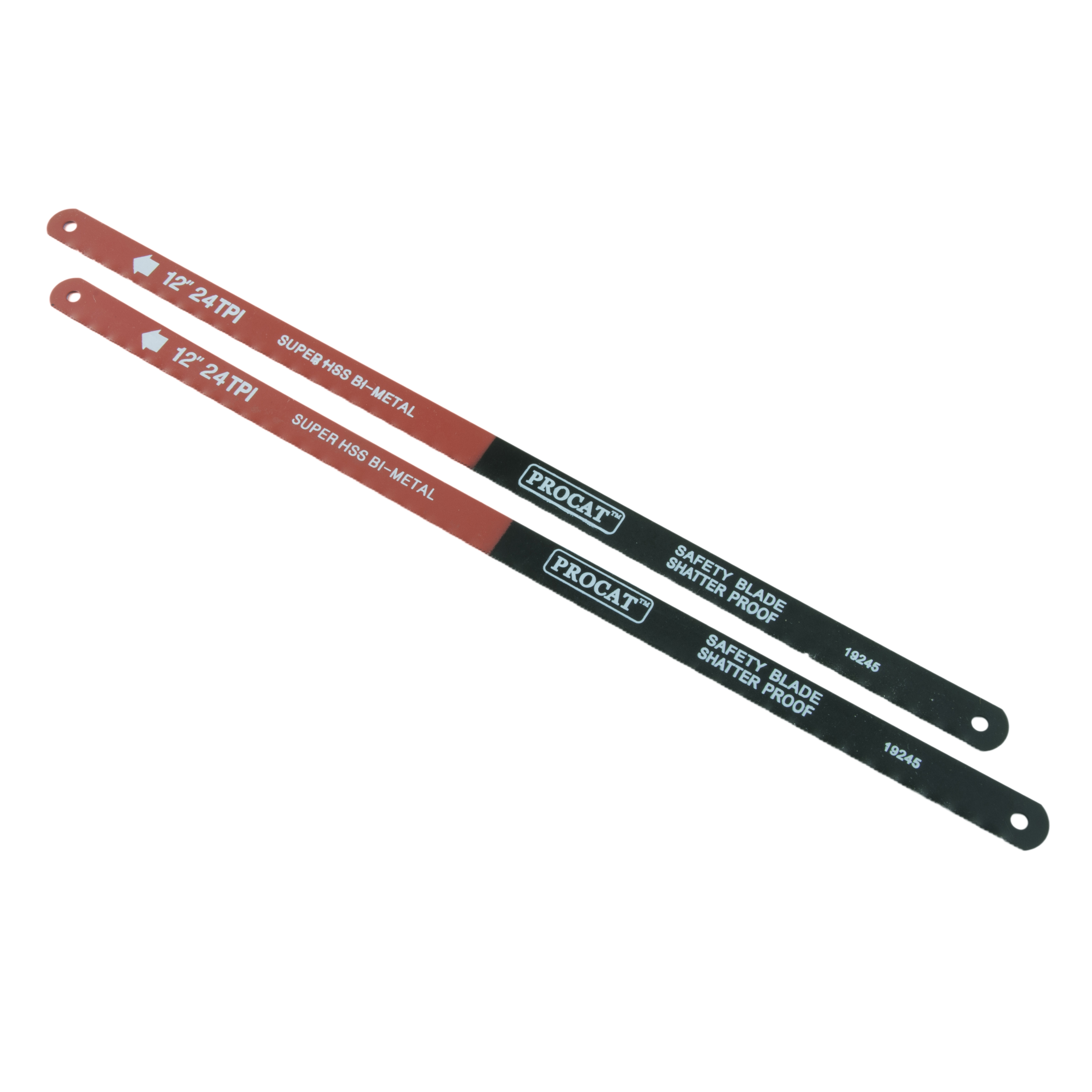
The blade cuts on the push stroke, that is, with the teeth pointing away from the handle. The light frame and plastic handle keep the saw controllable with one hand while the other hand supports the workpiece or guides the start of the cut. Any 300 mm hacksaw blade fits as a replacement, for example the Procat hacksaw blade IP bi-metal, 2 pcs / pack.
Intended use and suitability:
A hacksaw is used to cut metal and plastic profiles by hand where a power saw cannot be used. The sawing capacity is limited by the frame depth, that is, the distance between the blade and the back of the frame.
- Cutting pipes: shortening copper, brass and steel pipes on site when a pipe cutter will not fit.
- Threaded rods and bolts: cutting a threaded rod to length and cutting off excess thread from a bolt in a vice.
- Thin-walled profiles: cutting angle iron, flat bar and sheet metal profiles.
- Hard plastics: cutting plastic pipe, electrical conduit and sheet profiles with a neat edge.
- Aluminium and soft metals: shortening aluminium profiles and brass parts with fine teeth that do not catch in the soft material.
Package contents:
- 1 pc hacksaw, frame length 12″ (for 300 mm blade)
- 1 pc hacksaw blade 300 mm, 24 TPI (fitted)
Features:
- Metal frame: carries the blade tension and keeps the blade straight during the sawing stroke.
- Screw tensioning: the blade tension is adjusted with the screw at the end of the frame without separate tools.
- Replaceable blade: takes a standard-length 300 mm hacksaw blade with fixing holes at the ends.
- 24 TPI blade included: fine teeth for thin metal and hard plastic.
- Plastic handle: a light grip that does not conduct heat during long sawing.
Technical specifications:
- Blade size: 12″ (300 mm).
- Blade teeth: 24 TPI (teeth per inch).
- Frame material: metal.
- Handle material: plastic.
- Blade fixing: screw tensioning, pins in the holes at the blade ends.
- Replaceable blade: yes, standard-length 300 mm hacksaw blade.
- Cutting direction: push stroke, teeth pointing away from the handle.
Procat hacksaw Hobby 12″: instructions for use:
1. Fitting the blade: Loosen the tensioning screw at the end of the frame. Place the blade on the frame pins so that the teeth point forwards, away from the handle. Tighten the screw until the blade rings clearly when tapped. A slack blade twists, an overtightened blade breaks at the fixing hole.
2. Securing the workpiece: Clamp the workpiece in a vice as close as possible to the cutting point. Support thin-walled pipe with soft jaw pads so that it does not get crushed.
3. Starting the kerf: Start the kerf with short strokes, using your thumb as a blade guide, and move your thumb away as soon as the kerf has formed. Start at a shallow angle so that more teeth are in contact.
4. Sawing: Saw along the full length of the blade at a rate of about 40–60 strokes a minute. Press only on the push stroke and ease off on the return stroke; pressure on the return stroke dulls the teeth. Let the blade do the cutting: extra pressure does not speed up sawing but breaks off teeth.
5. Changing the blade: When sawing slows down or the blade starts to slip, change the blade: loosen the tensioning screw, remove the old blade and fit the new one with the teeth facing forwards.
6. Maintenance: Wipe swarf off the frame and blade after use. Release the blade tension for storage so that the frame is not left under tension. Store in a dry place.
Warnings:
- The blade teeth are sharp and a broken blade is extremely sharp: wear protective gloves when changing the blade.
- Wear safety glasses, as the blade can break and swarf flies from the cutting point.
- Clamp the workpiece in a vice. A workpiece held in the hand turns and the blade slips.
- Do not twist the blade sideways in the kerf; the blade breaks and fragments fly off.
- After sawing, the edge of the cut piece is sharp and may be hot.
- Store the saw out of the reach of children with the blade tension released.
Frequently asked questions (FAQ):
Which blade fits the Procat hacksaw Hobby 12″? A standard-length 300 mm (12″) hacksaw blade with fixing holes at the ends. A 24 TPI blade is supplied; a suitable replacement is, for example, the Procat hacksaw blade IP bi-metal, 2 pcs / pack.
What does 24 TPI mean? The blade has 24 teeth per inch. The finer the teeth, the thinner the material the blade suits; there should always be at least three teeth in the material in the kerf.
Which way should the teeth point? Away from the handle. A hacksaw cuts on the push stroke.
How tight should the blade be? Tight enough for the blade to ring clearly when tapped. A slack blade bends and twists in the kerf, an overtightened one breaks at the fixing hole.
Can the saw cut stainless steel? Yes, with slow, steady strokes and enough pressure. Stainless steel work-hardens if a tooth rubs the surface without cutting.
Why did the blade break? The most common causes are twisting the blade sideways in the kerf, too little tension and the workpiece moving during sawing.
Recycling instructions:
Sort a worn-out saw into its parts: the metal frame and blade go to metal recycling, the plastic handle to plastic recycling or the energy waste fraction. Protect the blade teeth with cardboard, for example, before disposal. The packaging cardboard goes to cardboard recycling. Collect metal swarf from sawing for metal recycling.