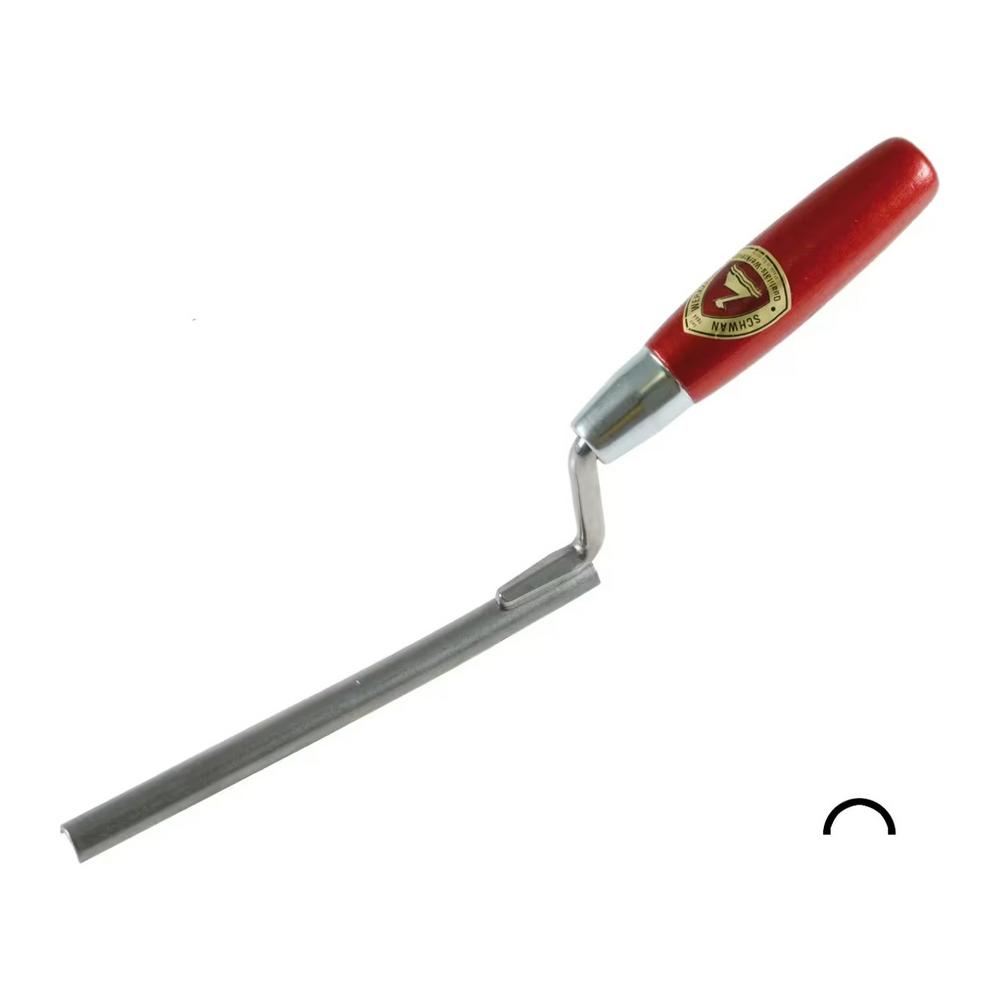

Description
The Schwan jointing iron curved (manufacturer’s name Hohle Fugenkelle) is a bricklayer’s jointing tool whose blade is a hollow U-channel, open at the bottom, bent down from the neck. The mortar inside the channel is shaped into a raised joint: a half-round joint that stands proud of the brick face. The blade length is 160 mm, and the tool is available in several blade widths to match the width of the masonry joint. The blade is steel and the handle wood with a metal ferrule.
The blade does not press the joint in but runs over the ridge of mortar: the edges of the U-channel rest on the faces of the bricks and the arc of the channel shapes the mortar in between into an even, rounded ridge. The result is a projecting joint with a smooth, dense surface. The neck bent downwards keeps your hand clear of the wall face, so the blade runs evenly in the joint.
The Schwan jointing iron curved completes Schwan’s range of jointing tools: this model makes a raised joint, while the straight Schwan jointing iron is intended for flush and recessed joints and the short Schwan end jointing iron 12×70 mm for vertical joints. The blade width is chosen to suit the joint; the widths are in the product variants.
Intended use and suitability:
The Schwan jointing iron curved is intended for shaping and finishing joints in brick, clinker and block masonry when you want the joint to have a half-round profile that stands proud of the brick face (raised joint).
- Facade masonry: The bed joints of fired bricks and clinkers are finished once the mortar has set “thumbprint hard”. The U-channel shapes the excess mortar into a smooth raised joint, so the surface of the joint is dense and withstands rain and frost better than an unshaped joint.
- Natural stone and calcium silicate brick walls: A raised joint covers the uneven edges of the stones, where a straight jointing iron would leave a gap. The blade width is chosen to match the joint width.
- Chimneys and fireplaces: A rounded raised joint guides water away from the outer surface of the chimney. The blade is also suitable for jointing with refractory mortar while the mortar can still be shaped.
- Repair masonry and repointing: After the old joint has been removed, new mortar is pressed into the joint and shaped with the same tool, so the repair matches the original joint profile.
Package contents:
- 1 pc Schwan jointing iron curved, in the selected blade width
Features:
- Hollow U-blade: The channel, open at the bottom, shapes the mortar into a half-round raised joint that stands proud of the brick face; not a pressed-in joint.
- Neck bent downwards: The handle is above the level of the blade, so your hand does not touch the wall face when drawing long joints.
- Blade length 160 mm: Enough to draw a bed joint along the length of a brick in one movement.
- Hardened steel: The blade withstands abrasive mortar and keeps its profile.
- Wooden handle with metal ferrule: The ferrule locks the blade to the handle; the wooden handle does not get cold in winter work.
- Made in Germany: Schwan Werkzeugfabrik, Remscheid.
Technical specifications:
- Product type: Raised-joint jointing iron, hollow U-blade (Hohle Fugenkelle)
- Blade length: 160 mm
- Blade width: Several, see variants
- Blade profile: Hollow U-channel open at the bottom (forms a raised joint), neck bent down
- Blade material: Hardened steel
- Handle: Wood, metal ferrule
- Country of manufacture: Germany
- Customs code: 8205 59 10 00
Schwan jointing iron curved instructions for use:
1. Let the jointing mortar set until it is thumbprint hard: pressing with a finger leaves a mark, but the mortar does not stick to the finger.
2. Place the U-channel over the ridge of mortar so that the edges of the channel rest on the faces of the bricks, and draw the blade along the bed joint with even pressure. The channel shapes the mortar into a rounded joint that stands proud of the surface. Do the bed joints first, then the vertical joints.
3. Once the mortar has dried, remove any mortar that came loose during shaping from the brick face with a soft brush.
4. Clean the blade with water immediately after work and dry it. Oil the blade lightly before long storage.
Warnings:
- The edges of the blade are thin: wear work gloves and keep the blade away from your face.
- Cement-based mortar is alkaline and irritates the skin and eyes. Wear protective gloves and safety glasses when jointing.
- Do not use the jointing iron as a lever or chisel; the thin blade can bend or break.
- A dry blade rusts in damp conditions; store in a dry place.
Frequently asked questions (FAQ):
Does the Schwan jointing iron curved make a pressed-in or a raised joint? A raised one: the blade is a U-channel open at the bottom, which shapes the mortar into a half-round raised joint that stands proud of the brick face. For a pressed-in, channel-shaped joint, a concave jointing iron (open at the top) is used.
How do I choose the blade width of the jointing iron? The blade width is chosen slightly narrower than the joint width, so that the blade fits in the joint and shapes the mortar right up to the edges.
When is the joint shaped after laying? When the mortar is thumbprint hard, usually 1–3 hours after laying depending on the weather and the mortar. Mortar that is too wet stains the brick; mortar that is too dry will not shape.
Is the Schwan jointing iron curved suitable for jointing clinkers? Yes, when the joint width matches the blade width and you want the joint to have a profile that stands proud of the surface.
Recycling instructions:
The Schwan jointing iron curved is supplied without separate packaging or in a cardboard shipping box; the cardboard is sorted for cardboard collection. A tool taken out of use is sorted for metal collection; the wooden handle can be removed and sorted as wood waste.